テキスト内容
この資料から読み取れるテキストです。
ENGLISH
RAIS - manual for RAIS 700
1
U s e r m a n u a l
M a n u e l d ’ u t i l i s a t e u r
G e b r u i k e r s h a n d l e i d i n g
R A I S 7 0 0
ENGLISH MANUAL...............................................................2-29
FRANÇAIS MANUEL D’UTILISATEUR .................................30-51
FLEMISH GEBRUIKERSHANDLEIDING ...............................52-73
Manufacturer’s Plate for RAIS 700
Plaque signalétique de RAIS 700
Merkplaatje voor RAIS 700
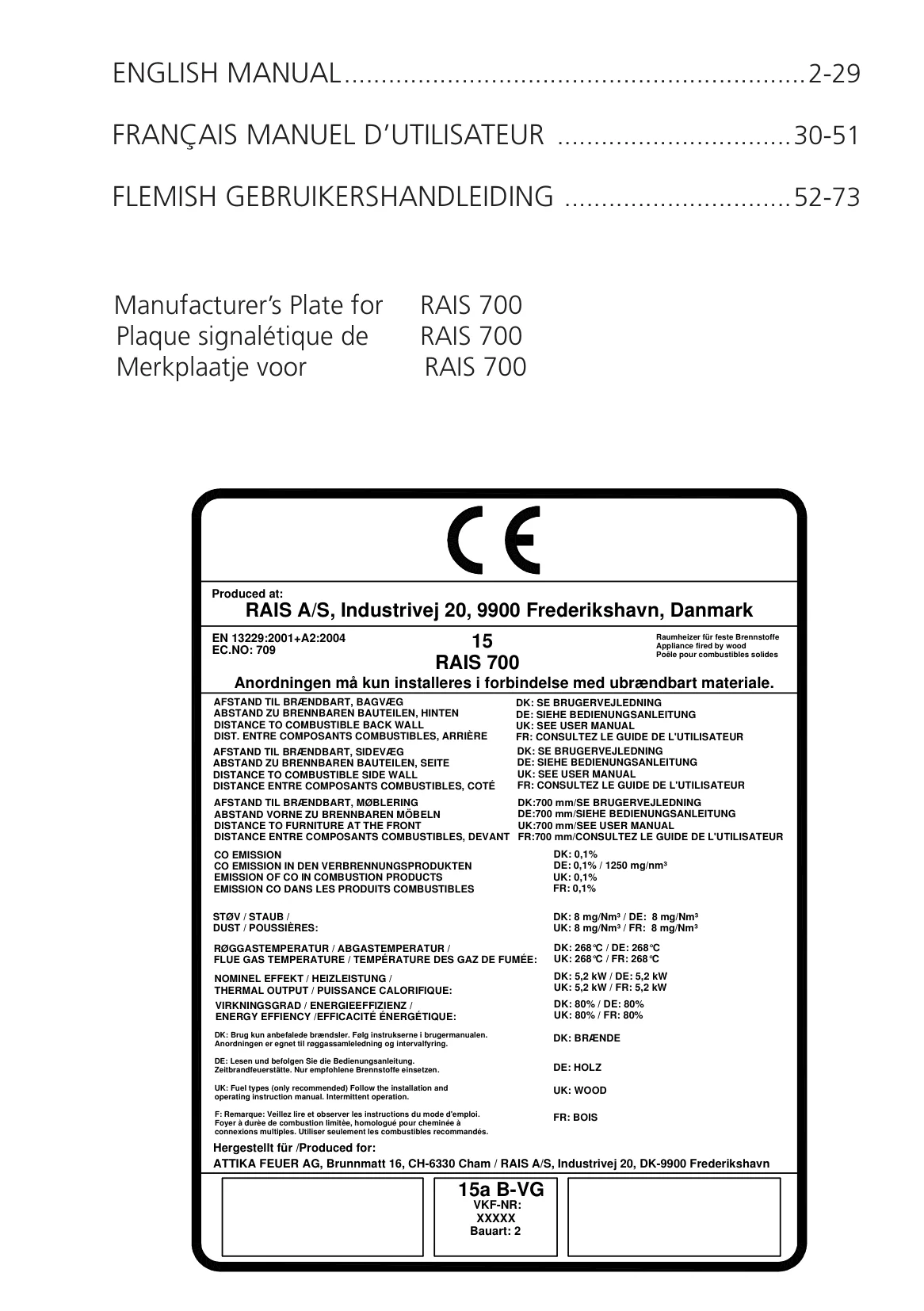
EN 13229:2001+A2:2004
Raumheizer für feste Brennstoffe
Appliance fired by wood
Poêle pour combustibles solides
Produced at:
RAIS A/S, Industrivej 20, 9900 Frederikshavn, Danmark
VKF-NR:
XXXXX
Bauart: 2
15a B-VG
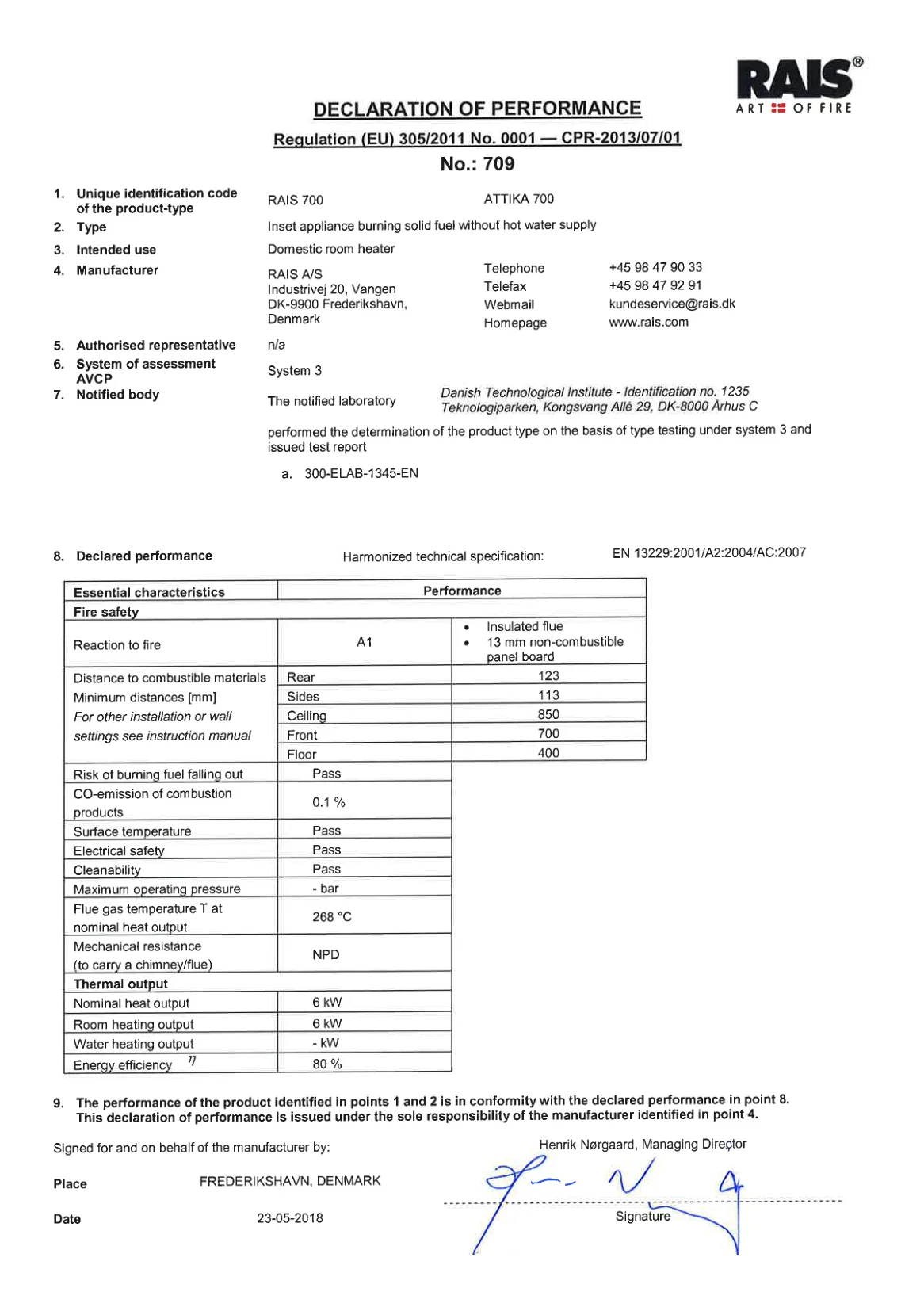
EC.NO: 709
Anordningen må kun installeres i forbindelse med ubrændbart materiale.
AFSTAND TIL BRÆNDBART, BAGVÆG
ABSTAND ZU BRENNBAREN BAUTEILEN, HINTEN
DISTANCE TO COMBUSTIBLE BACK WALL
DIST. ENTRE COMPOSANTS COMBUSTIBLES, ARRIÈRE
AFSTAND TIL BRÆNDBART, SIDEVÆG
ABSTAND ZU BRENNBAREN BAUTEILEN, SEITE
DISTANCE TO COMBUSTIBLE SIDE WALL
DISTANCE ENTRE COMPOSANTS COMBUSTIBLES, COTÉ
AFSTAND TIL BRÆNDBART, MØBLERING
ABSTAND VORNE ZU BRENNBAREN MÖBELN
DISTANCE TO FURNITURE AT THE FRONT
DISTANCE ENTRE COMPOSANTS COMBUSTIBLES, DEVANT
CO EMISSION
CO EMISSION IN DEN VERBRENNUNGSPRODUKTEN
EMISSION OF CO IN COMBUSTION PRODUCTS
EMISSION CO DANS LES PRODUITS COMBUSTIBLES
NOMINEL EFFEKT / HEIZLEISTUNG /
THERMAL OUTPUT / PUISSANCE CALORIFIQUE:
RØGGASTEMPERATUR / ABGASTEMPERATUR /
FLUE GAS TEMPERATURE / TEMPÉRATURE DES GAZ DE FUMÉE:
VIRKNINGSGRAD / ENERGIEEFFIZIENZ /
ENERGY EFFIENCY /EFFICACITÉ ÉNERGÉTIQUE:
DK: Brug kun anbefalede brændsler. Følg instrukserne i brugermanualen.
Anordningen er egnet til røggassamleledning og intervalfyring.
DE: Lesen und befolgen Sie die Bedienungsanleitung.
Zeitbrandfeuerstätte. Nur empfohlene Brennstoffe einsetzen.
UK: Fuel types (only recommended) Follow the installation and
operating instruction manual. Intermittent operation.
F: Remarque: Veillez lire et observer les instructions du mode d'emploi.
Foyer à durèe de combustion limitèe, homologué pour cheminée à
connexions multiples. Utiliser seulement les combustibles recommandés.
Hergestellt für /Produced for:
ATTIKA FEUER AG, Brunnmatt 16, CH-6330 Cham / RAIS A/S, Industrivej 20, DK-9900 Frederikshavn
STØV / STAUB /
DUST / POUSSIÈRES:
DK: 8 mg/Nm³ / DE: 8 mg/Nm³
UK: 8 mg/Nm³ / FR: 8 mg/Nm³
DK: 268°C / DE: 268°C
UK: 268°C / FR: 268°C
DK: 5,2 kW / DE: 5,2 kW
UK: 5,2 kW / FR: 5,2 kW
DK: 80% / DE: 80%
UK: 80% / FR: 80%
DK: BRÆNDE
DE: HOLZ
UK: WOOD
FR: BOIS
DK: SE BRUGERVEJLEDNING
DE: SIEHE BEDIENUNGSANLEITUNG
UK: SEE USER MANUAL
FR: CONSULTEZ LE GUIDE DE L'UTILISATEUR
DK: SE BRUGERVEJLEDNING
DE: SIEHE BEDIENUNGSANLEITUNG
UK: SEE USER MANUAL
FR: CONSULTEZ LE GUIDE DE L'UTILISATEUR
DK:700 mm/SE BRUGERVEJLEDNING
DE:700 mm/SIEHE BEDIENUNGSANLEITUNG
UK:700 mm/SEE USER MANUAL
FR:700 mm/CONSULTEZ LE GUIDE DE L'UTILISATEUR
DK: 0,1%
DE: 0,1% / 1250 mg/nm³
UK: 0,1%
FR: 0,1%
15
RAIS 700
1
3
2
5
7
6
4
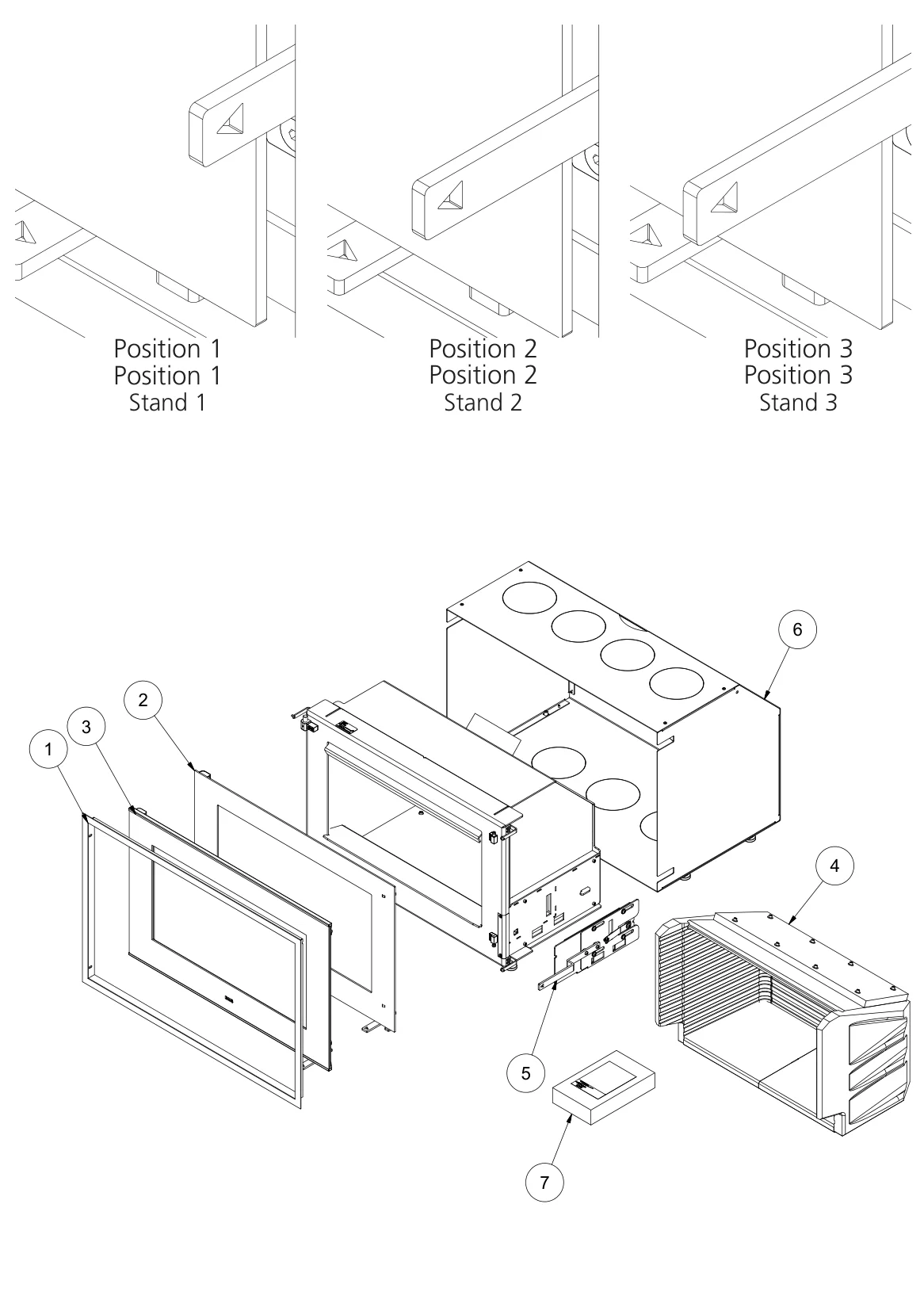
Position 1
Position 1
Stand 1
Position 2
Position 2
Stand 2
Position 3
Position 3
Stand 3
We cannot be held responsible for any misprints.
The oven is wrapped in packaging that is recyclable. This must
be disposed of according to national rules regarding the dis
posal of waste.
The glass can not be reused.
The glass should be discarded along with the residual waste
from
ceramics and porcelain.
Pyrex glass has a higher melting temperature and therefore can
not be reused.
If discarded you make an important positive contribution to
the environment.
FIRE ENVIRONMENTALLY FRIENDLY!
5 Eco-friendly advices for sensible heating
- common sense both environmentally and economically.
1. Effective lighting. Use dry brushwood, kindling and possible a piece of news
paper. Open the air damper, so plenty of air is fed to the stove and the gases
from the heated wood can burn rapidly.
2. Light the fire with only little wood at a time - this gives the best combustion.
Remember plenty of air for every time new wood is added.
3. When the flames are diminished, adjust the air damper so that the air supply
is reduced
4. When only glowing embers remain, air flow can be reduced further, so heat
ing demand is just covered. With a lower air supply the charcoal will burn
slower and the heat loss through the chimney is reduced.
5. Use only dry wood - ie wood with a humidity of 15 to 22 percent.
ENGLISH RAIS - manual for RAIS 700
5
Rais 700
Revision: 6
Dato : 08-11-2021
INTRODUCTION ............................................................................................................4
WARRANTY ..................................................................................................................4
SPECIFICATIONS.............................................................................................................5
INSTALLATIONS INSTRUCTIONS......................................................................................6
CONVECTION ...............................................................................................................7
CHIMNEY....................................................................................................................7-8
VENTILATION.................................................................................................................9
INSTALLATION ........................................................................................................10-11
INSTALLATION DISTANCE .......................................................................................12-17
FUEL ......................................................................................................................18-19
REGULATION OF COMBUSTION AIR ............................................................................19
USING THE WOOD BURNING STOVE ...........................................................................20
ADJUSTMENT OF AIR DAMPER ....................................................................................20
CONTROL....................................................................................................................20
FIRST USAGE................................................................................................................20
IMPORTANT - WARNING NOTE................................................................................21-22
LIGHTING AND FUELLING ............................................................................................23
CLEANING AND CARE .................................................................................................24
CLEANING OF THE FLUE WAYS.....................................................................................25
INTERRUPTION OF OPERATION ....................................................................................26
ACCESSORIES AND SPARE PARTS.................................................................................27
ENGLISH
RAIS - manual for RAIS 700
6
Distributor:
Date:
Introduction
Thank you for purchasing a RAIS wood burning stove.
These appliances have been approved by HETAS Ltd as
intermittent operating appliances for burning wood logs only.
A RAIS wood burning stove is more than just a heat source: it also shows that you care
about design and quality in your home.
To make the most of your wood burning stove it is important that you read the manual
thoroughly, before installing and using it.
In the case of warranty coverage, and for general queries regarding your wood burning
stove, it is important that you know the stove’s production number.
We therefore recommend that you note down the number in the table below. The pro
duction number is located in the top of the convex box.
Warranty
Your RAIS wood burning stove comes with a 5 year warranty. The warranty, however,
does not cover heat-insulating materials, glass and seals.
Any alterations made to the stove will void the warranty.
ENGLISH RAIS - manual for RAIS 700
7
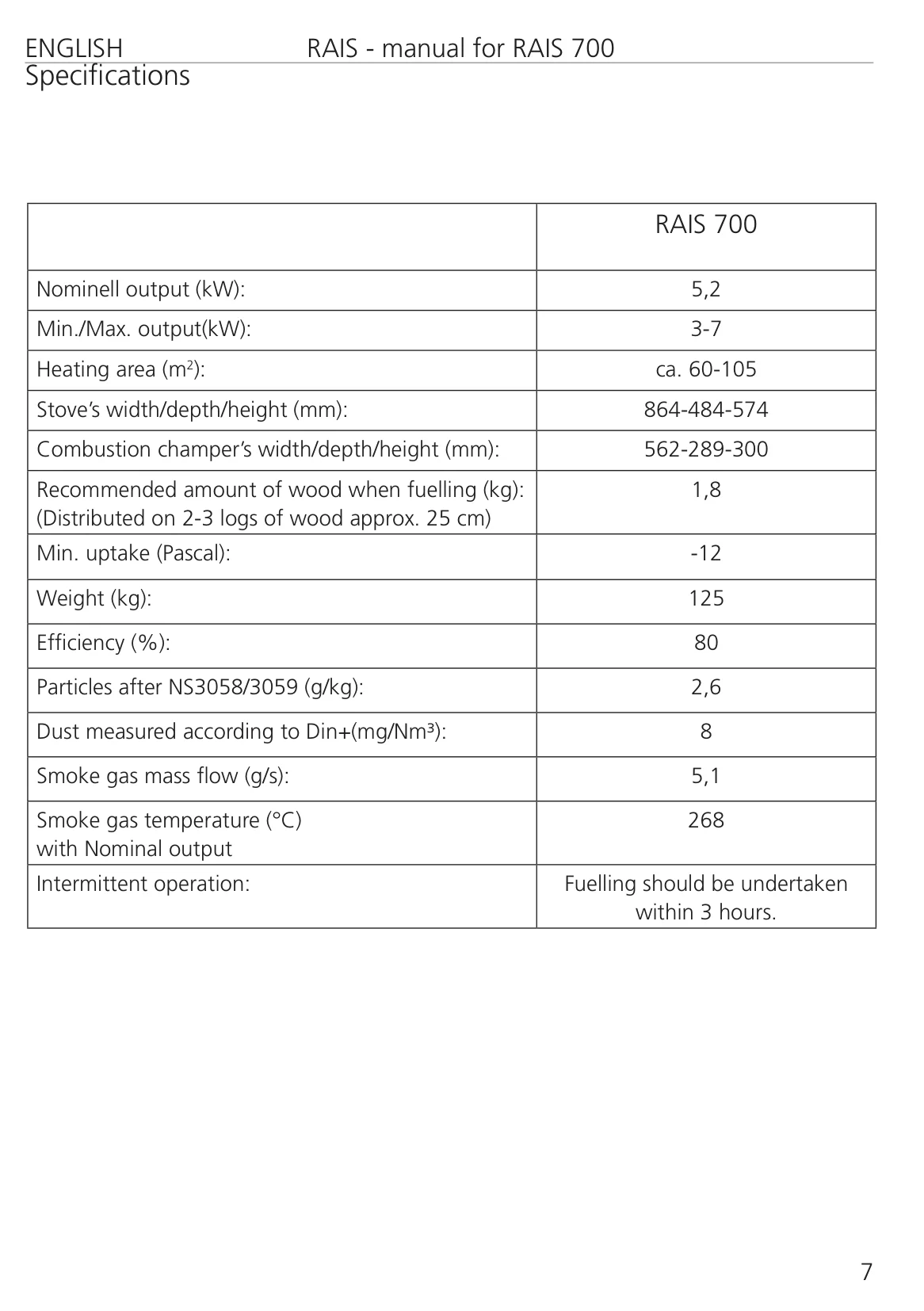
Specifications
RAIS 700
Nominell output (kW):
5,2
Min./Max. output(kW):
3-7
Heating area (m2):
ca. 60-105
Stove’s width/depth/height (mm):
864-484-574
Combustion champer’s width/depth/height (mm):
562-289-300
Recommended amount of wood when fuelling (kg):
(Distributed on 2-3 logs of wood approx. 25 cm)
1,8
Min. uptake (Pascal):
-12
Weight (kg):
125
Efficiency (%):
80
Particles after NS3058/3059 (g/kg):
2,6
Dust measured according to Din+(mg/Nm³):
8
Smoke gas mass flow (g/s):
5,1
Smoke gas temperature (°C)
with Nominal output
268
Intermittent operation:
Fuelling should be undertaken
within 3 hours.
ENGLISH
RAIS - manual for RAIS 700
8
Installation instructions
The following pages give instructions for the safe and proper installation of this heating
appliance in the UK. These instructions cover the basic principles of installation, although
detail may need slight modification to suit particular local site conditions. In all cases the
installation must comply with current UK Building Regulations, Local Authority Byelaws
and other specifications or regulations as they affect the installation of the stove. Please
note that it is a legal requirement under England and Wales Building Regulations that
the installation of the stove is either carried out under Local Authority Building Control
approval or is installed by a Competent Person registered with a Government approved
Competent Persons Scheme. HETAS Ltd operate such a Scheme and a listing of their Reg
istered Competent Persons can be found on their website at www.hetas.co.uk.
It should be noted that the current Building Regulations requirements are given in Ap
proved Document J. These requirements may also be met by adopting the relevant recom
mendations given in British Standards BS 8303, BS 6461 and BS 7566.
WARNING: Health and Safety Advice Notice
The installation of this heating appliance is governed by the Health and Safety at Work
Act 1974. It is the responsibility of the installer to ensure that all requirements of this Act
are met during the installation works. Attention is drawn in particular to the following:
Handling: The appliance is a heavy item and adequate facilities must be available for
loading, unloading and site handling.
Fire Cement: Some types of fire cement are caustic and should not be allowed to come
into contact with the skin. Protective gloves should be worn when handling
fire cement. In case of contact with the skin wash immediately with plenty
of water.
Asbestos: This stove contains no asbestos. If there is a possibility of disturbing any
asbestos in the course of installation then please seek specialist guidance
and use appropriate protective equipment.
Metal Parts: When installing or servicing this stove care should be taken to avoid the
possibility of personal injury.
Important Warning –Preparatory Work and Safety Checks:
•
This stove must not be installed into a chimney that serves any other heating appli
ance.
•
There must not be an extractor fan fitted in the same room as the stove as this can
cause the stove to emit fumes into the room.
•
If this appliance is installed into an existing chimney, the chimney must first be swept
and examined for soundness and suitability before the appliance is installed (see also
section headed “Chimney”).
ENGLISH RAIS - manual for RAIS 700
9
Convection
RAIS stoves are convection stoves. This means that the stove’s back and side panels are
not over-heated. Convection means that there is a circulation of air, which ensures that
the heat is distributed more evenly throughout the entire room. The cold air is sucked in
at the base of the stove up through the convection channel, which runs along the stove’s
combustion chamber. The heated air pours out at the top of the stove, which ensures a
circulation of warm air throughout the room.
The stoves are equipped with “cold” door handles – RAIS special feature – which means
you could almost do away with gloves. Be aware, however, that all exterior surfaces be
come hot during use - so take extreme care.
Chimney
The chimney is the driving force which makes the stove function. In order for the stove to
perform satisfactorily the chimney height must be sufficient to ensure the correct draught
of 14 to 18 Pa so as to clear the products of combustion and prevent problems of smoke
emanating into the room when firing.
NOTE: A chimney height of not less than 4.5 metres measured vertically from the outlet
of the stove to the top of the chimney should be satisfactory. Alternatively the calcula
tion procedure given in BS 5854:1980 may be used as the basis for deciding whether a
particular chimney design will provide sufficient draught.
The outlet from the chimney should be above the roof of the building in accordance with
the provisions of Building Regulations Approved Document J.
If installation is into an existing chimney then it must be sound and have no cracks or
other faults which might allow fumes into the house. Older properties, especially, may
have chimney faults or the cross section may be too large i.e. more than 230 mm x 230
mm. Remedial action should be taken, if required, seeking expert advice, if necessary. If it
is found necessary to line the chimney then a flue liner suitable for solid fuel must be used
in accordance with Building Regulations Approved Document J.
Any existing chimney must be clear of obstruction and have been swept clean immedi
ately before installation of the stove. If the stove is fitted in place of an open fire then the
chimney should be swept one month after installation to clear any soot falls which may
have occurred due to the difference in combustion between the stove and the open fire.
If there is no existing chimney then either a prefabricated block chimney in accordance
with Building Regulations Approved Document J or a twin walled insulated stainless steel
flue to BS 4543 can be used. These chimneys must be fitted in accordance with the manu
facturer’s instructions and Building Regulations.
ENGLISH
RAIS - manual for RAIS 700
10
A single wall metal fluepipe is suitable for connecting the stove to the chimney but is not
suitable for using for the complete chimney. The chimney and connecting fluepipe must
have a minimum diameter of 150 mm and its dimension should be not less than the size
of the outlet socket of the stove which is 150 mm in diameter. Any bend in the chimney
or connecting fluepipe should not exceed 45°. 90°bends should not be used.
Combustible material should not be located where the heat dissipating through the walls
of fireplaces or flues could ignite it. Therefore when installing the stove in the presence
of combustible materials due account must be taken of the guidance on the separation
of combustible material given in Building Regulations Approved Document J and also in
these stove instructions.
If it is found that there is excessive draught in the chimney then either an adjustable flue
damper or alternatively a draught stabiliser should be fitted. The adjustable flue damper
should not close off the flue entirely but should in its closed position leave a minimum
continuous opening free area of at least 20 % of the total cross sectional area of the flue
or fluepipe.
Adequate provision e.g. easily accessible soot door or doors must be provided for sweep
ing the chimney and connecting fluepipe.
You should also familiarise yourself with the draught conditions for chimneys with 2 flues.
The flue outlet spigot is 150 mm in diameter.
For strong draughts, the chimney or flue should be fitted with a draught stabiliser. In
which case, it is important to ensure that there is a free flow-through area of minimum
20 cm² when the regulating gate is shut. Otherwise, the fuel energy may not be used
optimally. If, at any time, you are unsure about the condition of the chimney, you should
contact a chimney sweep.
Remember that access to the access door should be kept clear.
ENGLISH RAIS - manual for RAIS 700
11
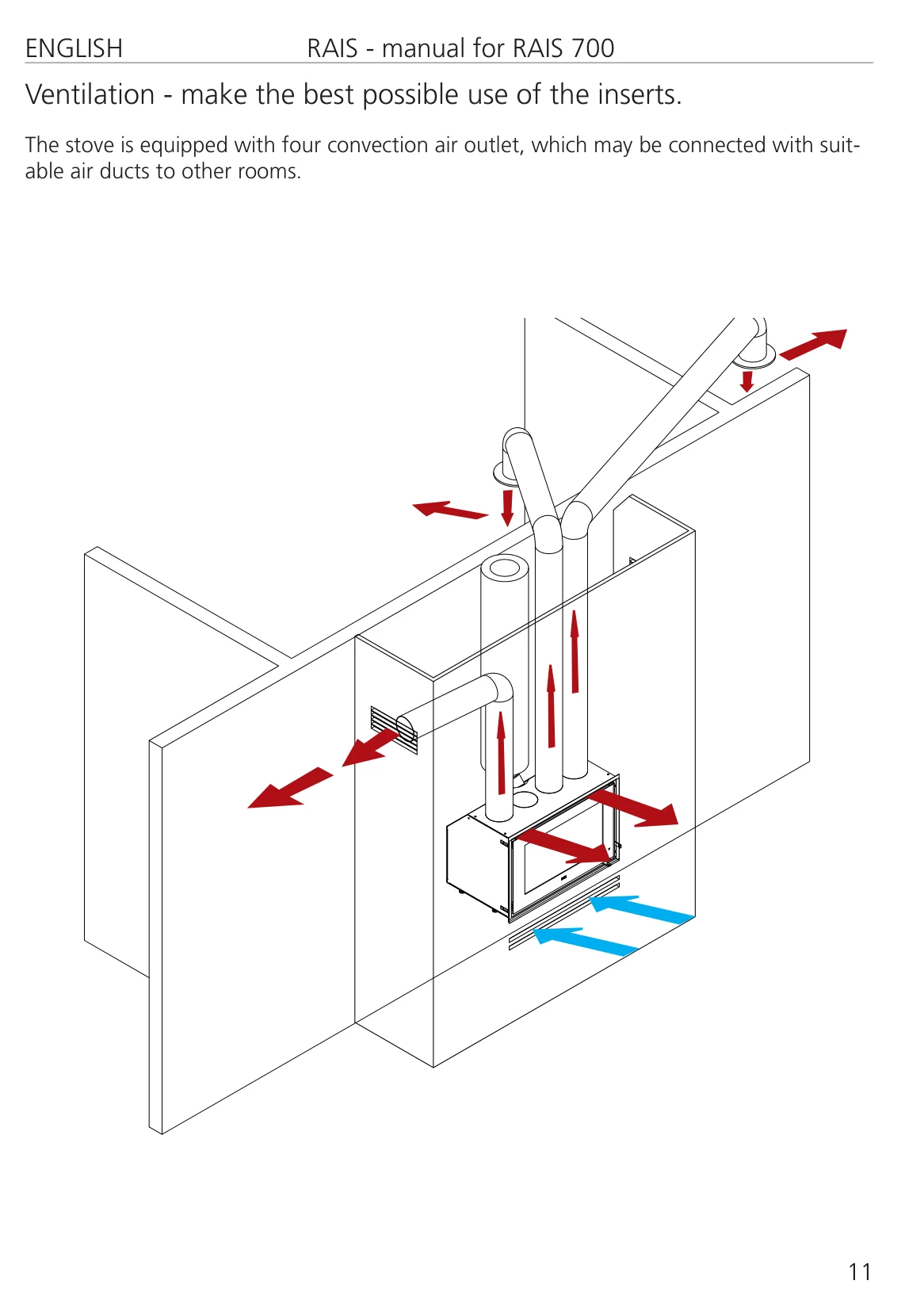
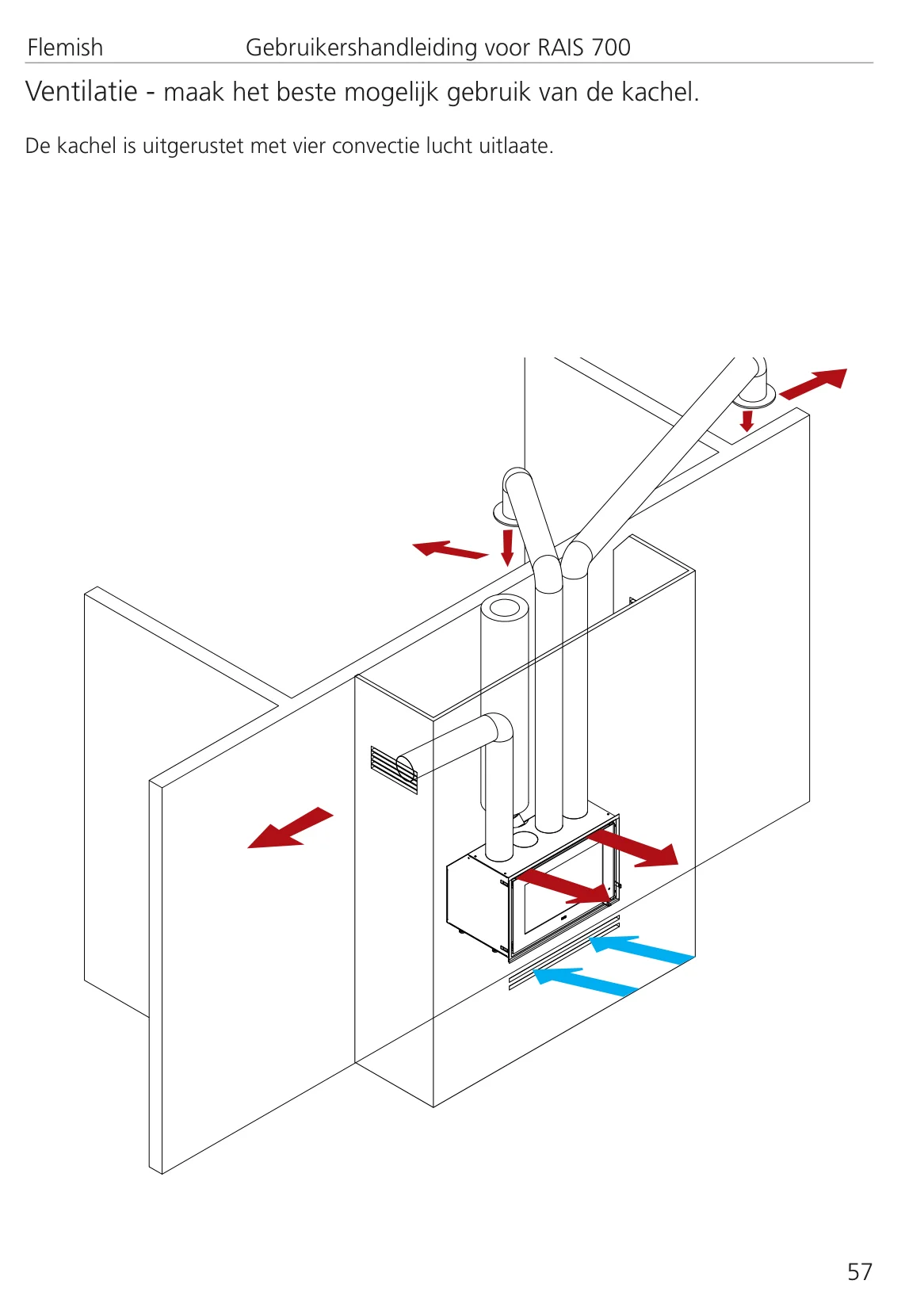
Ventilation - make the best possible use of the inserts.
The stove is equipped with four convection air outlet, which may be connected with suit
able air ducts to other rooms.
ENGLISH
RAIS - manual for RAIS 700
12
Installation
It is prohibited to carry out unauthorised alterations to the stove.
There must be plenty of fresh air in the room where the stove is being installed, in order
to ensure proper combustion. Note that any mechanical exhaust ventilation - e.g. an
extraction hood - may reduce the air supply. Any air grates must be placed in such a man
ner, that the air supply is not blocked.
The stove is equipped with four convection air outlets, which may be connected with suit
able air ducts to other rooms.
Building Regulations Approved document J gives specific guidance on the required
permanent ventilation into the room for combustion air of solid fuel appliances.
The floor structure must be able to carry the weight of the wood burning stove, as well as
the weight of a chimney, if necessary.
When you choose where to set up your RAIS wood burning stove, you should consider
the heat distribution to the other rooms. This will enable you to get the best use out of
your stove. The stove should be set up at a safe distance from inflammable materials. See
the manufacturer’s plate on the wood burning stove.
Installation of stove:
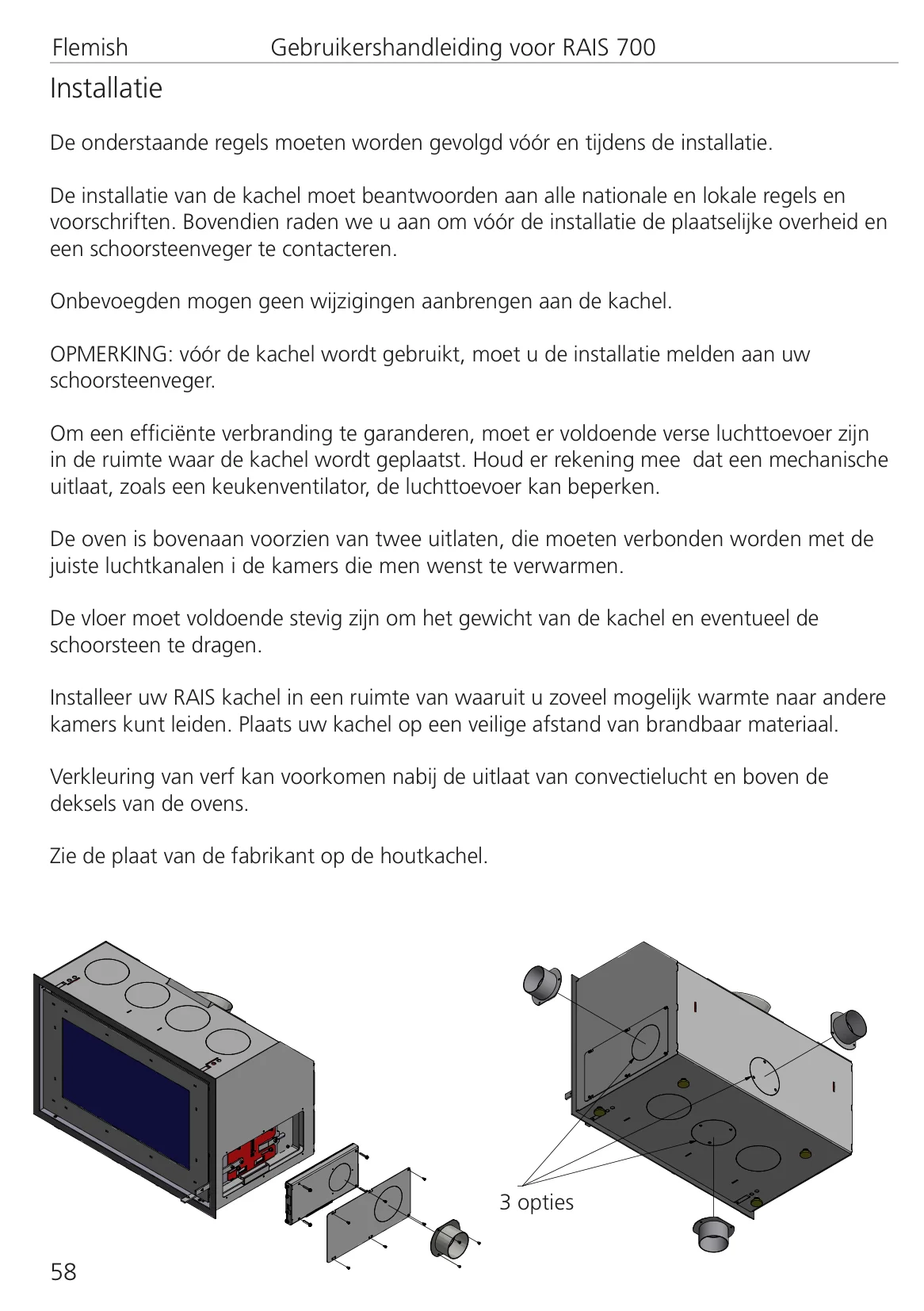
NOTE: Decision to be taken concerning the placement of the inlets and outlets of the
convection system. The area requirements for convection holes to be kept.
Miscolouring of the wall above the doors and the convection air outlets may
occur due to raising hot air.
RAIS cannot take responsibility for building in or consequential damage.
The stove to be inspected for defects at receipt.
ENGLISH RAIS - manual for RAIS 700
13
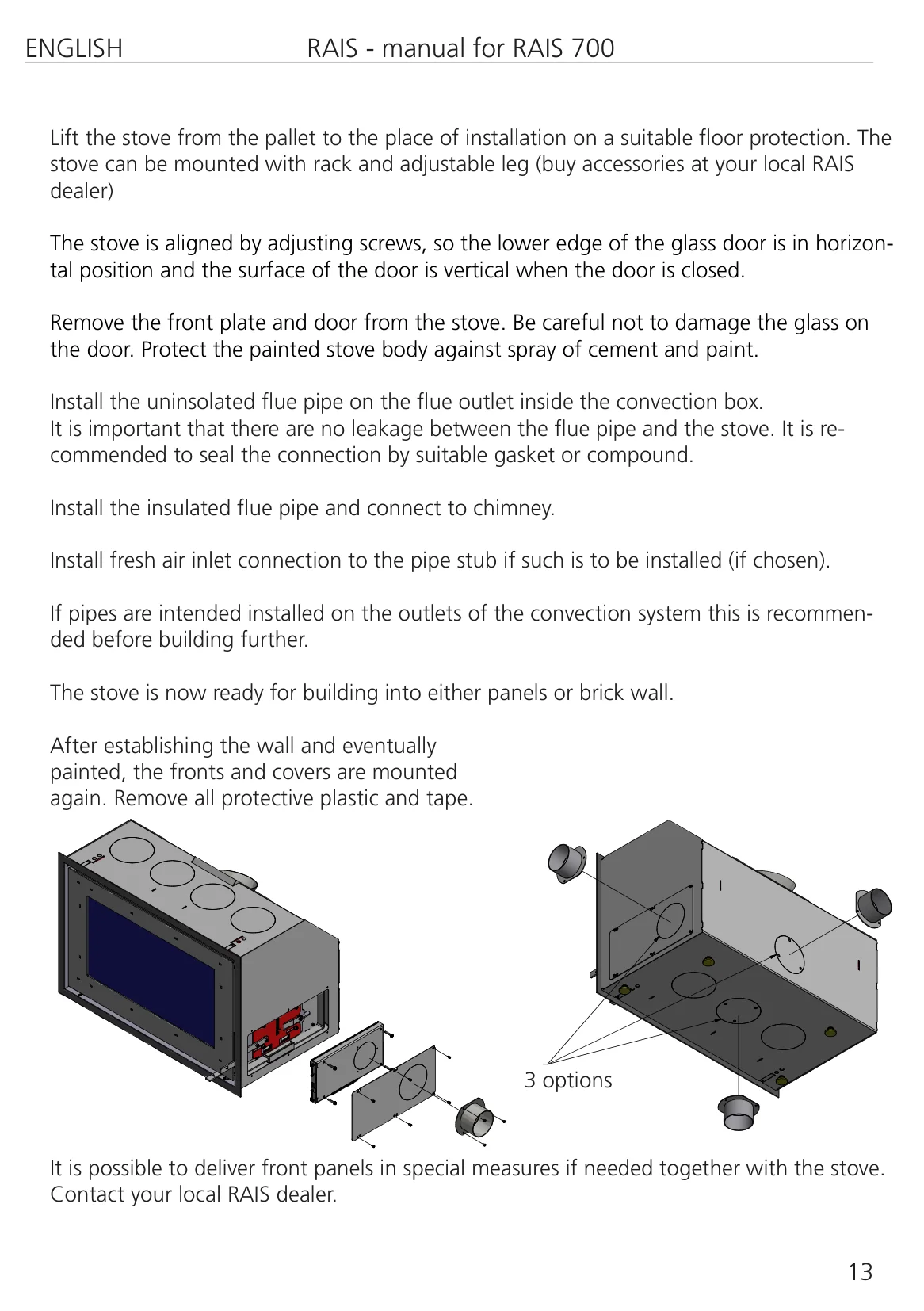
Lift the stove from the pallet to the place of installation on a suitable floor protection. The
stove can be mounted with rack and adjustable leg (buy accessories at your local RAIS
dealer)
The stove is aligned by adjusting screws, so the lower edge of the glass door is in horizon
tal position and the surface of the door is vertical when the door is closed.
Remove the front plate and door from the stove. Be careful not to damage the glass on
the door. Protect the painted stove body against spray of cement and paint.
Install the uninsolated flue pipe on the flue outlet inside the convection box.
It is important that there are no leakage between the flue pipe and the stove. It is re
commended to seal the connection by suitable gasket or compound.
Install the insulated flue pipe and connect to chimney.
Install fresh air inlet connection to the pipe stub if such is to be installed (if chosen).
If pipes are intended installed on the outlets of the convection system this is recommen
ded before building further.
The stove is now ready for building into either panels or brick wall.
After establishing the wall and eventually
painted, the fronts and covers are mounted
again. Remove all protective plastic and tape.
It is possible to deliver front panels in special measures if needed together with the stove.
Contact your local RAIS dealer.
3 options
ENGLISH
RAIS - manual for RAIS 700
14
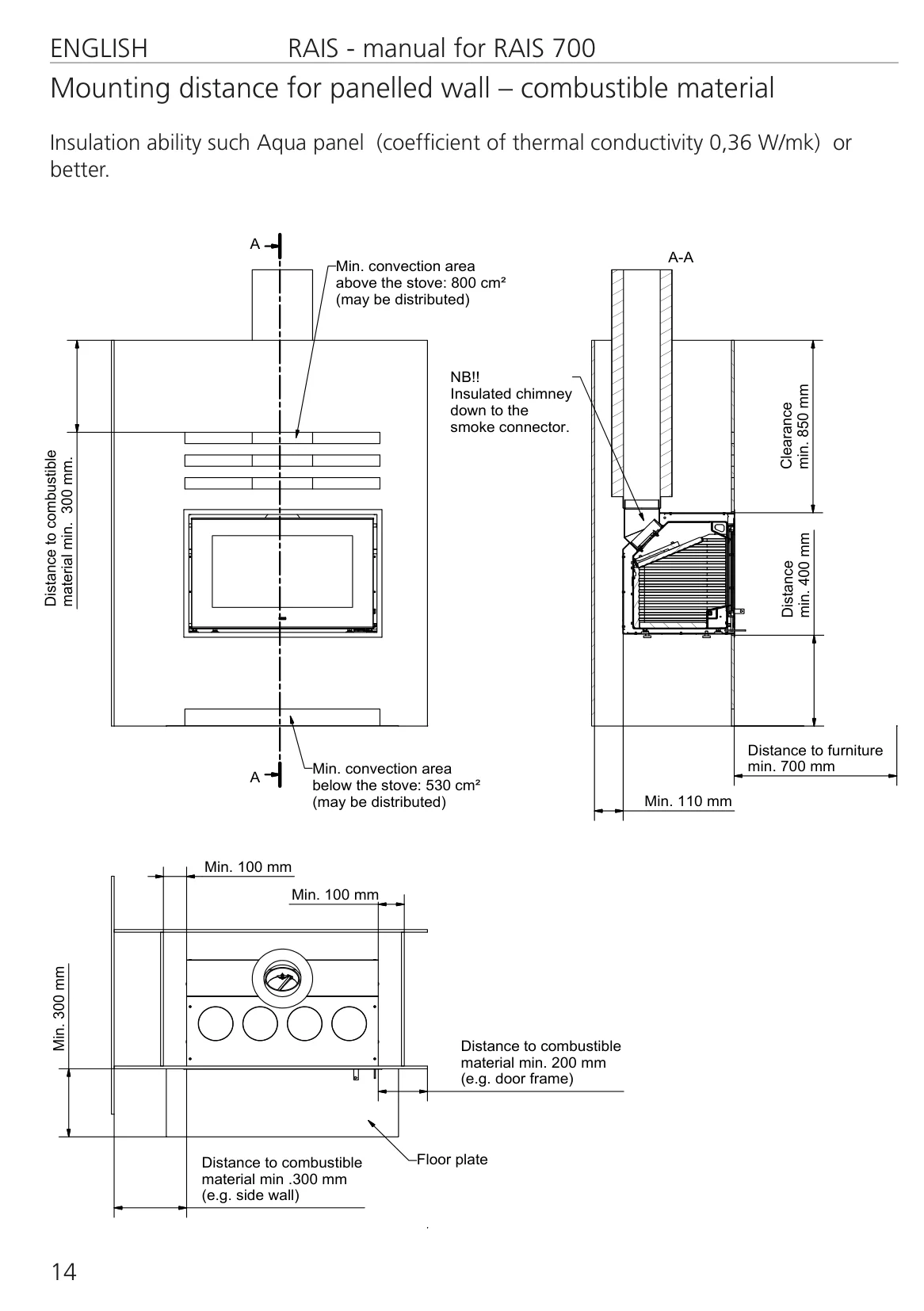
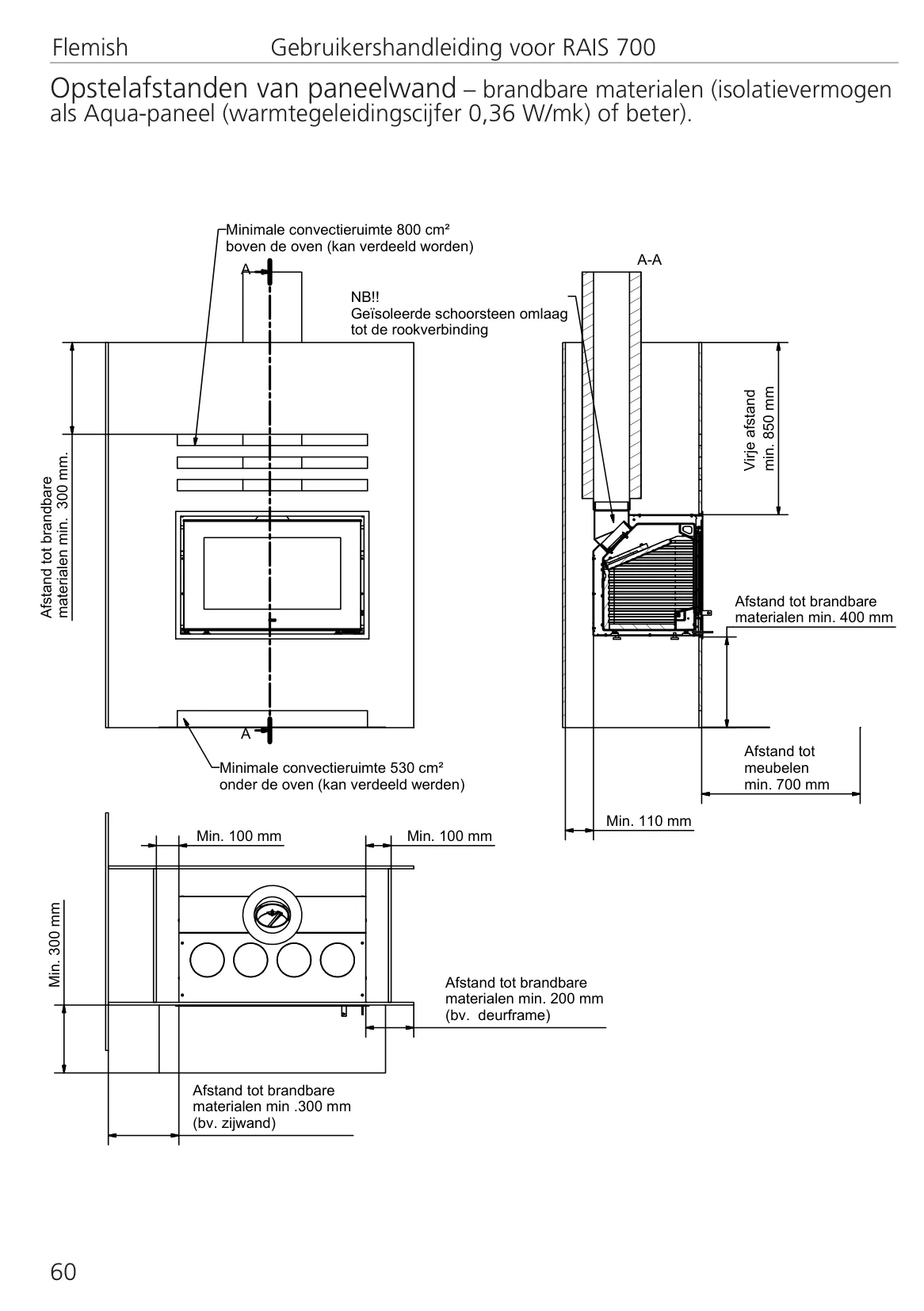
Mounting distance for panelled wall – combustible material
Insulation ability such Aqua panel (coefficient of thermal conductivity 0,36 W/mk) or
better.
A-A
AA
110
Min.
mm
850
min.
mm
Clearance
400
min.
mm
Distance
300
material min .
mm
Distance to combustible
(e.g. side wall)
200
material min.
mm
Distance to combustible
(e.g. door frame)
100
Min.
mm
100
Min.
mm
300
Min.
mm
Min. convection area
above the stove: 800 cm²
(may be distributed)
Min. convection area
below the stove: 530 cm²
(may be distributed)
300
material min.
mm.
Distance to combustible
NB!!
Insulated chimney
down to the
smoke connector.
Floor plate
700
min.
mm
Distance to furniture
ENGLISH RAIS - manual for RAIS 700
15
A-A
AA
Min. convection area
above the stove : 800 cm²
(may be distributed)
Min convection area
below the stove: 530 cm²
(may be distributed)
300
material min.
mm
Distance to combustible
850
min.
mm
Clearance
400
min.
mm
Distance
110
Min.
mm
50
Min.
mm
50
Min.
mm
200
area min.
mm
Distance to combustible
(e.g. door frame)
300
area min.
mm
Distance to combustible
(e.g. side wall)
300
Min.
mm
700
min.
mm
Distance to furniture
Floor plate
NB!!
Insulated chimney
down to the
smoke connector.
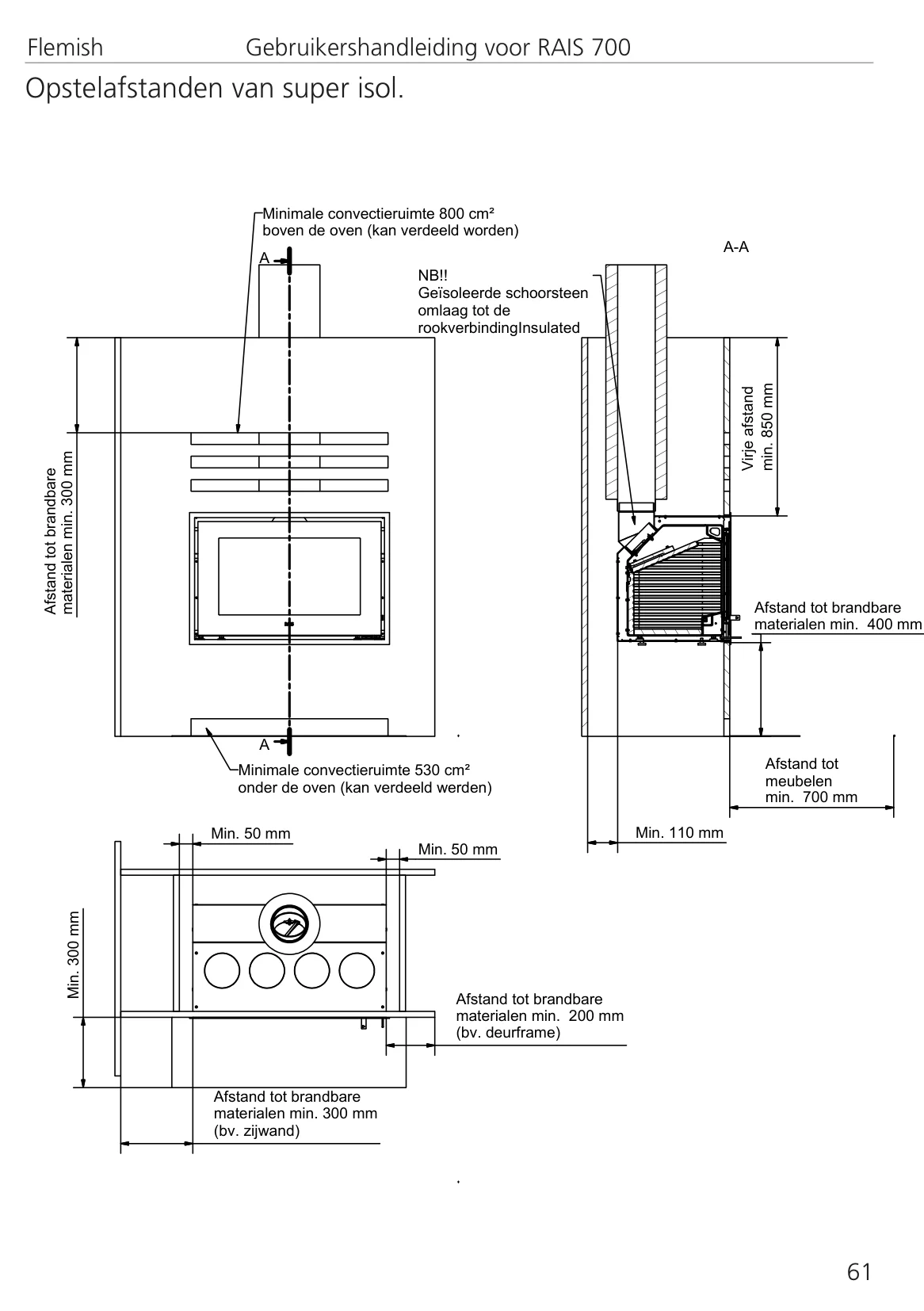
Mounting distance - super isol
ENGLISH
RAIS - manual for RAIS 700
16
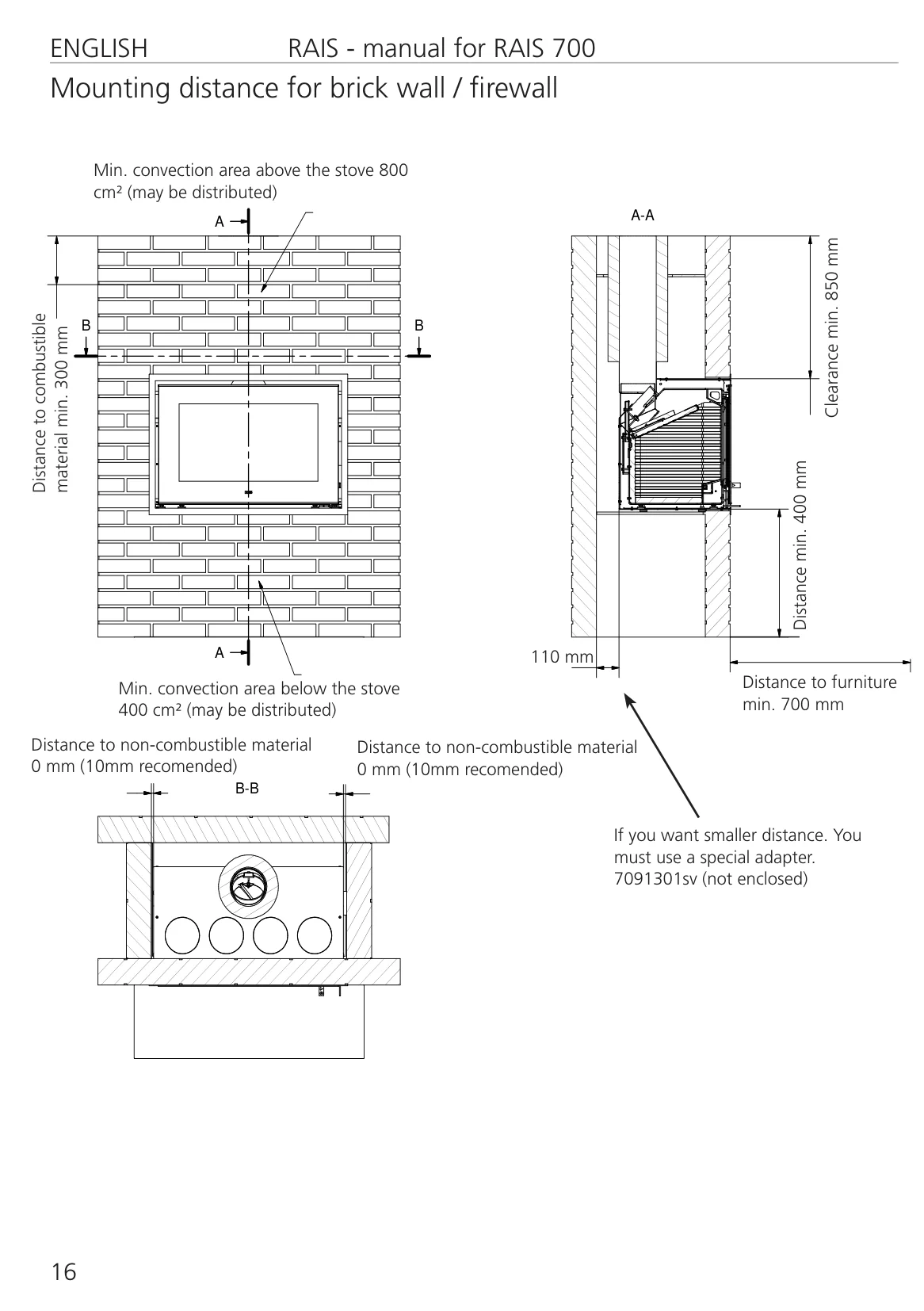
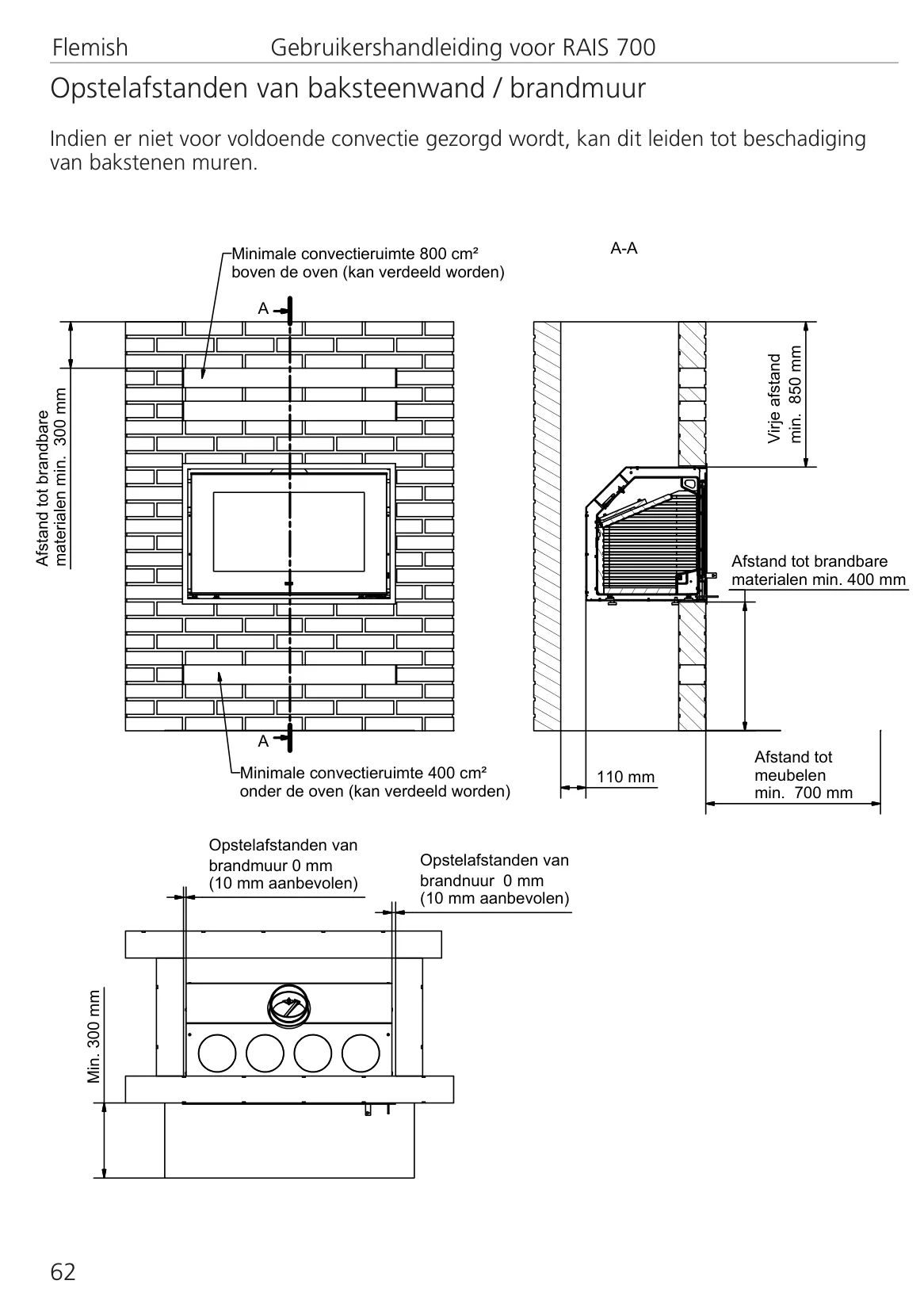
Mounting distance for brick wall / firewall
A-A
B-B
AABB
Min. convection area above the stove 800
cm² (may be distributed)
Distance to combustible
material min. 300 mm
Min. convection area below the stove
400 cm² (may be distributed)
Distance to non-combustible material
0 mm (10mm recomended)
Distance to non-combustible material
0 mm (10mm recomended)
Clearance min. 850 mm
Distance min. 400 mm
Distance to furniture
min. 700 mm
110 mm
If you want smaller distance. You
must use a special adapter.
7091301sv (not enclosed)
ENGLISH RAIS - manual for RAIS 700
17
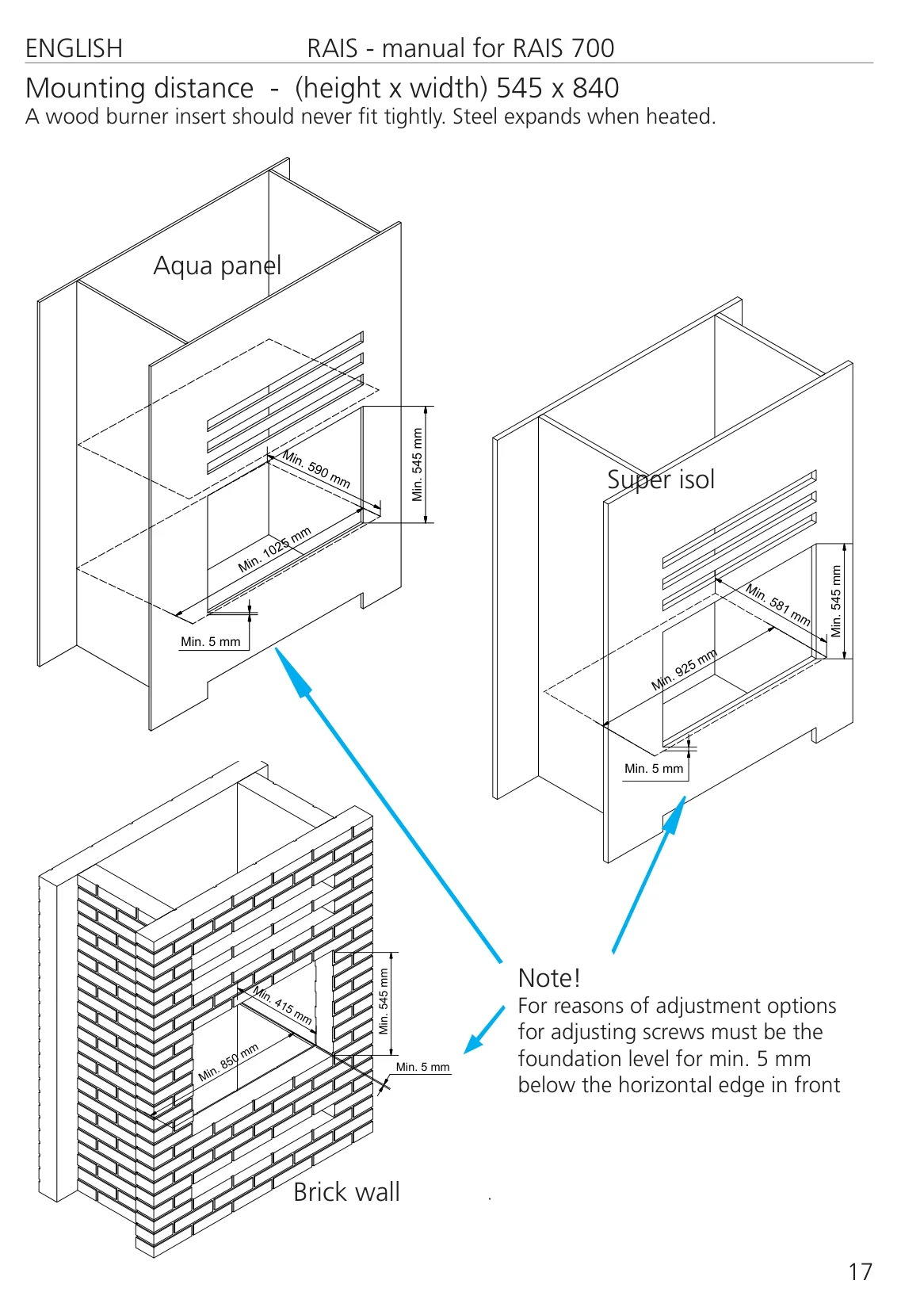
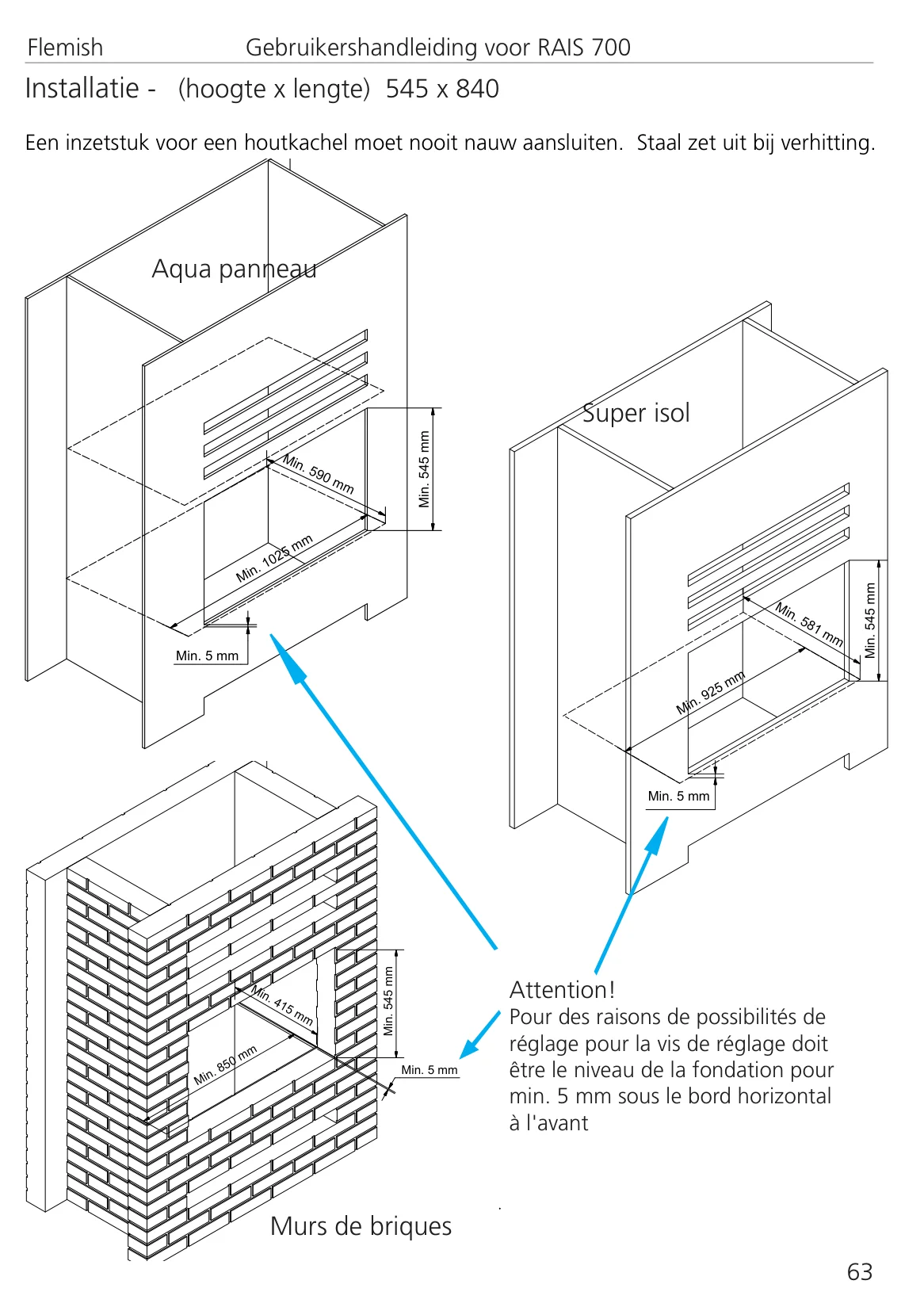
Mounting distance - (height x width) 545 x 840
A wood burner insert should never fit tightly. Steel expands when heated.
Aqua panel
Super isol
Brick wall
545
Min.
mm
850
Min.
mm
415
Min.
mm
5
Min. mm
1025
Min.
mm
590
Min.
mm
545
Min.
mm
5
Min. mm
581
Min.
mm
925
Min.
mm
545
Min.
mm
5
Min. mm
Note!
For reasons of adjustment options
for adjusting screws must be the
foundation level for min. 5 mm
below the horizontal edge in front
ENGLISH
RAIS - manual for RAIS 700
18
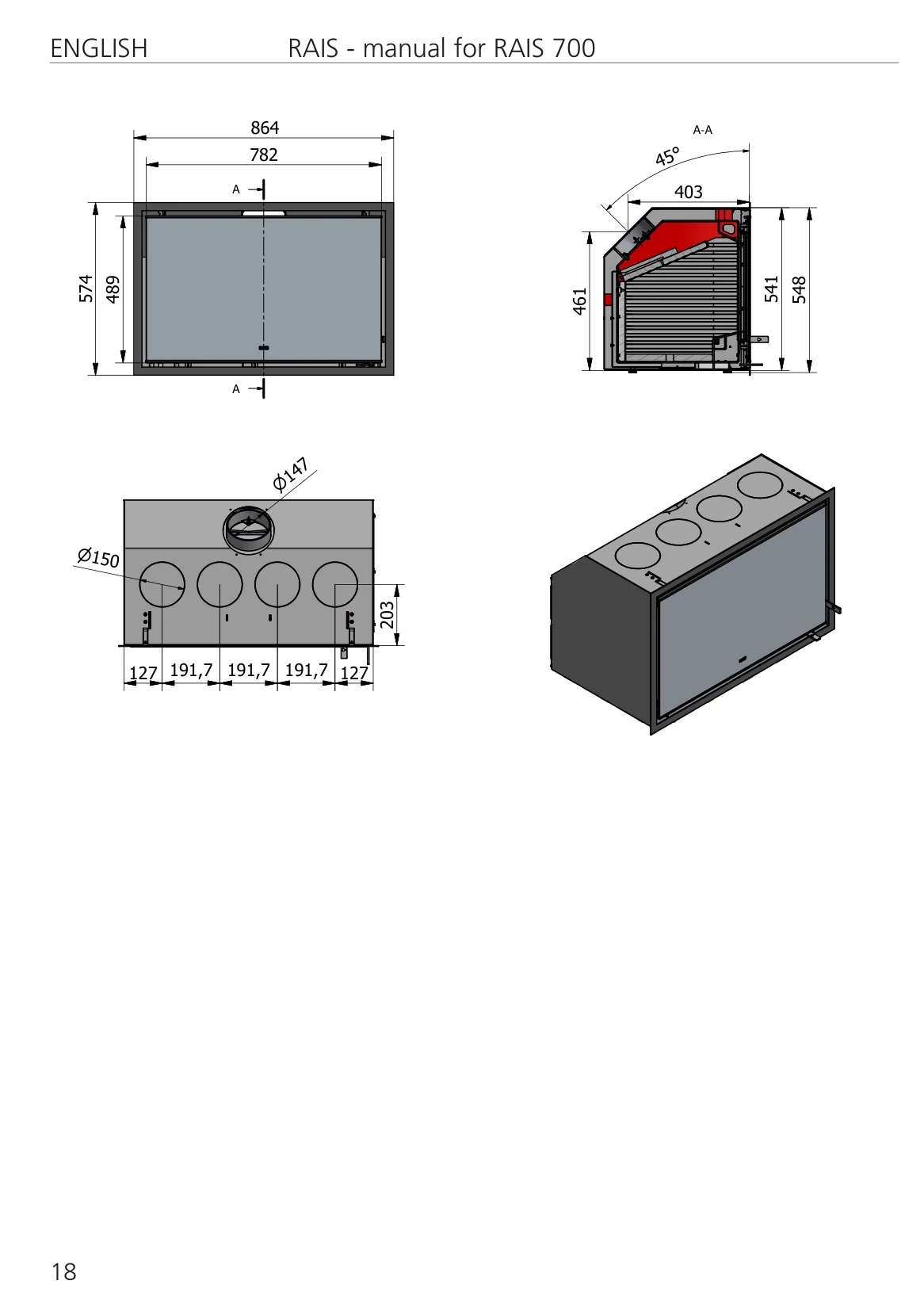
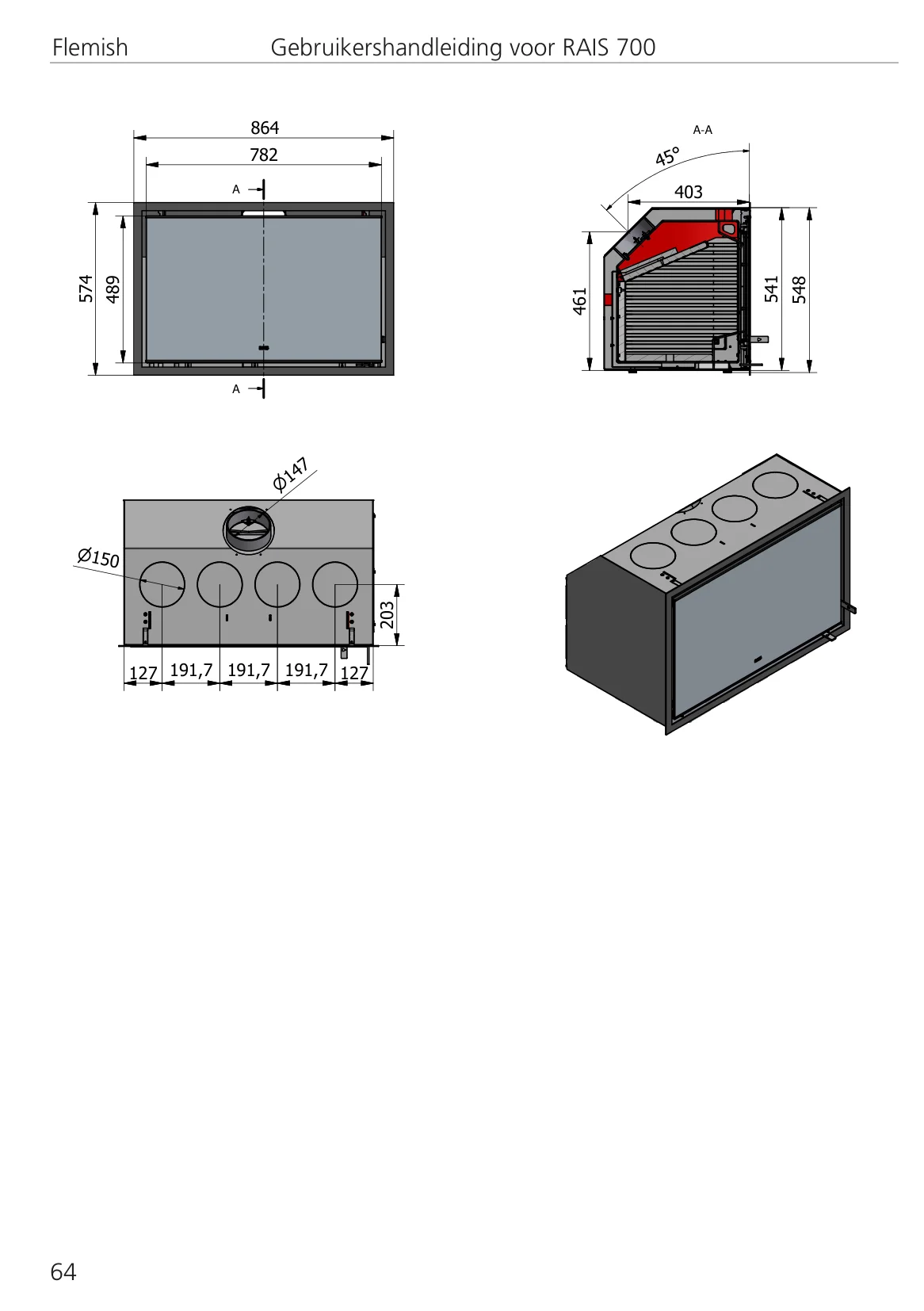
AA
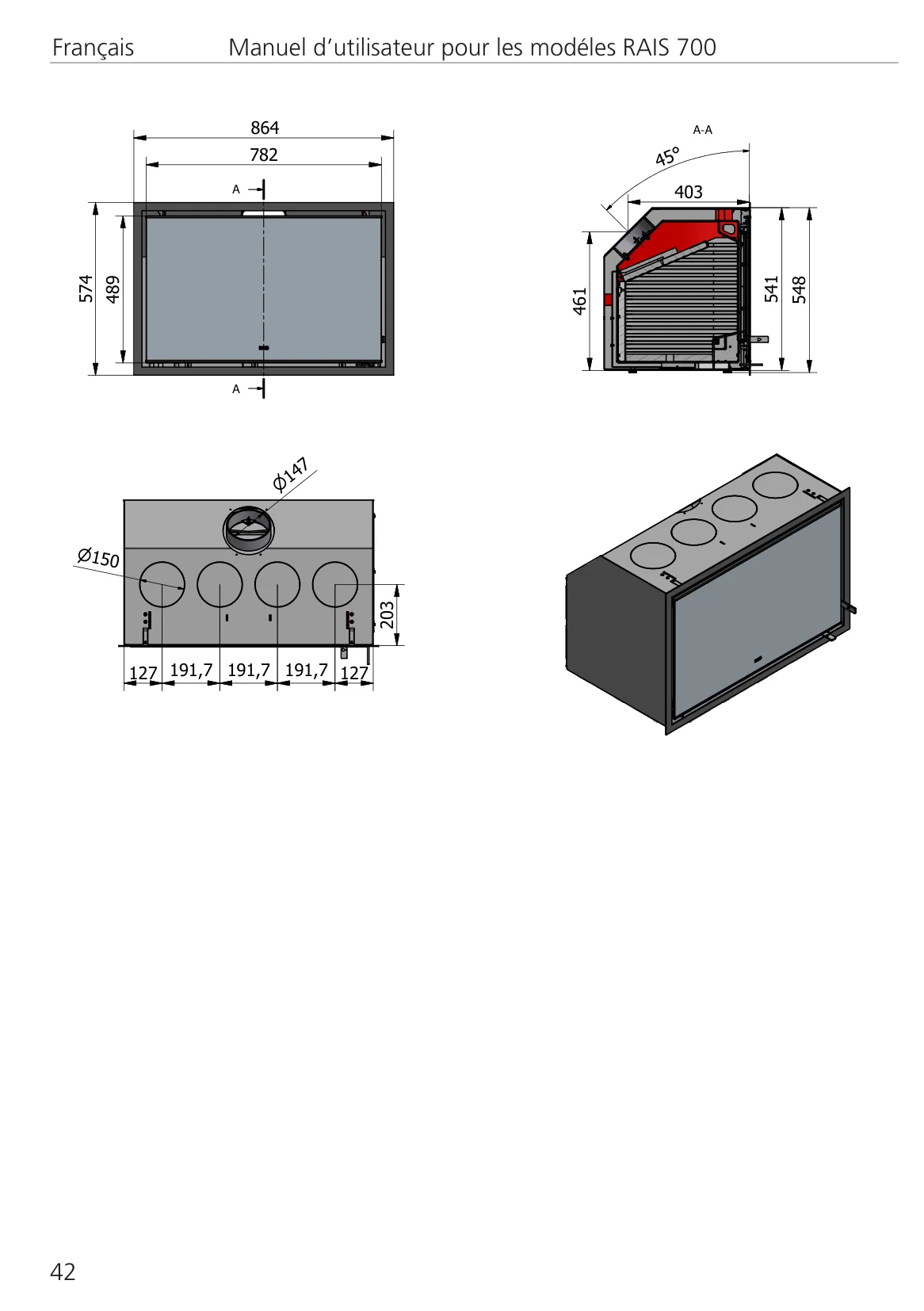
864
782
489
574
127 191,7
191,7
191,7 127
n150
n147
203
A-A
403
461
45°
541
548
ENGLISH RAIS - manual for RAIS 700
19
Installation distance in case of combustible wall
To find out whether the wall next to where the stove is going to be installed is flammable,
you should contact your building contractor or the local building authorities.
The hearth should be able to accommodate the weight of the stove. The chimney must
be independently supported by wall brackets or a ceiling support plate. The weight of the
stove is indicated in the brochure.
The stove should always be installed on a non-combustible hearth of a size and construc
tion that is in accordance with the provisions of the current UK Building Regulations Ap
proved Document J.
If the stove is to be installed on a wooden floor, it must be covered with a noncombustible
material at least 12mm thick, in accordance with UK Building Regulations Approved Docu
ment J, to a distance of 300 mm in front of the stove and 150 mm to each side measuring
from the door of the combustion chamber.
The clearance distances to combustible material beneath, surrounding or upon the hearth
and walls adjacent to the hearth should comply with the guidance on the separation of
combustible material given in UK Building Regulations Approved Document J and also in
these stove instructions.
For the Installer
Finally before firing the stove for the first time a check should be made to ensure that the
assembly and stove installation has been satisfactory and that there are no leaks in any
seals in the appliance and appliance connections to the chimney.
Ensure that the appliance and chimney flue are functioning correctly before finally hand
ing over to the user. If necessary read the later parts of this manual for guidance on care
required when first lighting.
Inform the user that the appliance has been commissioned and ready to use and give
instruction on the safe operation of the stove.
These Instructions must be left with the user and the user should be instructed to keep
them in a safe place.
ENGLISH
RAIS - manual for RAIS 700
20
Operating instructions
Please note that HETAS Ltd Appliance Approval only covers the use of dry sea
soned wood logs on this appliance. HETAS Ltd Approval does not cover the use
of other fuels either alone or mixed with the wood logs, nor does it cover instruc
tions for the use of other fuels.
Fuel
The stove is designed and approved in accordance with EN 13240 and NS 3058 for stok
ing split, dried firewood. The firewood must have a water content of 15-22% and its max.
length should be the length of the combustion chamber minus 50-60 mm.
Stoking with wet firewood causes both soot, environmental pollution and bad fuel
economy. Freshly cut wood contains approx. 50-70% water and is thoroughly unsuitable
for stoking. Count min. 1 year of storage time for newly cut wood before using.
Wood with a diameter of more than 100 mm should be split. Regardless of wood size, it
should always have at least one surface area free of bark.
We do not recommend stoking with painted, laminated or impregnated wood, wood with
a synthetic surface, painted refuse wood, chipboard, plywood, domestic waste, paper bri
quettes and pit coal, as this will produce malodorous smoke, which could be poisonous.
When firing with the above-mentioned items and amounts larger than those recommend
ed, the stove is subjected to a larger amount of heat, which results in a higher chimney
temperature and lower efficiency. This can result in the stove and chimney becoming dam
aged and would void the warranty.
The calorific value of the firewood is closely connected to the moisture level of the
firewood. Moist firewood has a low heat value. The more water the wood contains, the
more energy it takes for this water to vaporise, resulting in this energy being lost.
ONLY USE RECOMMENDED FUELS
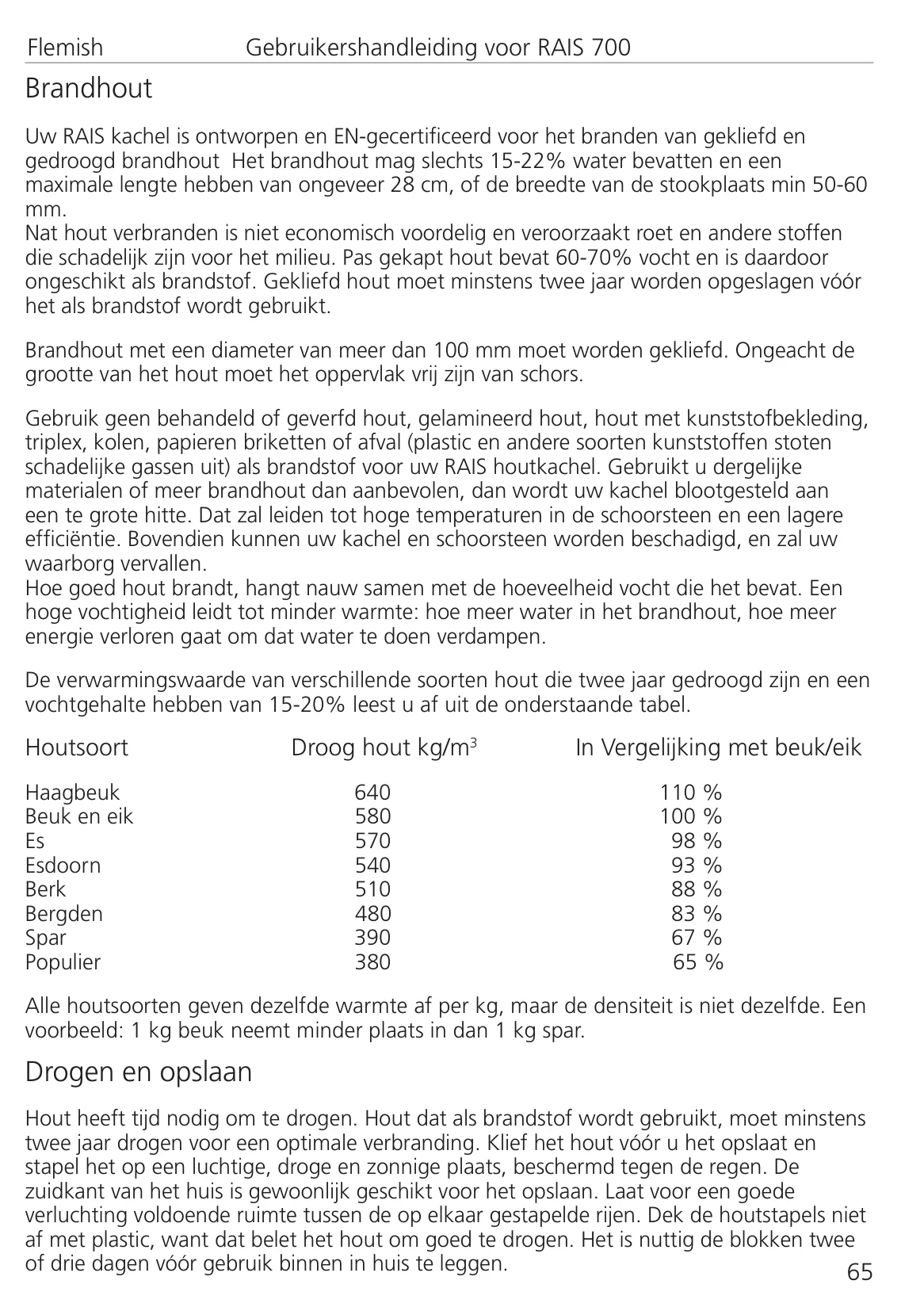
The following table shows the calorific value of different types of wood, which have been
stored for 2 years, and which have a residual moisture of 15-17%.
Wood
Kg dry wood pr. m3
compared to beech/oak
Hornbeam
640
110%
Beech and oak
580
100%
Ash
570
98%
Maple
540
93%
Birch
510
88%
Mountain pine
480
83%
Fir
390
67%
Poplar
380
65%
1 kg of wood yields the same heat energy irrespective of wood type. 1 kg beech merely
takes up less space than 1 kg of fir.
ENGLISH RAIS - manual for RAIS 700
21
Drying and storage
Drying wood takes time: proper air drying takes approx. 2 years.
Here are some tips:
Store the wood sawn, split and stacked in an airy, sunny place, which is protected against
rain (the south side of the house is particularly suitable).
Store the firewood stacks at a hand’s breadth apart, as this ensures that the air flowing
through takes the moisture with it. Avoid covering the firewood stacks with plastic, as
this prevents the moisture from escaping. It is a good idea to bring the firewood into the
house 2-3 days before you need it.
Regulating the combustion air
All RAIS stoves are equipped with a one-handed operating lever for regulating the damp
er. The stove-specific regulating mechanisms can be seen on the diagrams.
Primary air is the combustion air added to the primary combustion zone, i.e. the bed of
glowing embers. This air, which is cold, is only used in the lighting stage.
Secondary air is the air which is added in the gas combustion zone, i.e. air which contrib
utes to the combustion of the pyrolysis gasses (preheated air, which is used for the cleaner
glass system and combustion). This air is sucked through the damper under the combus
tion chamber and is pre-heated through the side channels and then emitted as hot scav
enging air onto the glass. The hot air rinses the glass and keeps it soot-free.
The tertiary channel, which can be seen at the the top of the combustion chamber to
wards the back, serves to combust the final gas residues.
By setting the interval between position 1 and 2, the energy content in the firewood is
used optimally, as there is oxygen for combustion and for the burning of the pyrolysis
gasses. When the flames are a clear yellow the damper has been set correctly. Finding the
correct position comes with time after you have used for stove for a while.
It is not recommended that you turn it down completely. A mistake commonly made is
shutting the damper too early because it feels too hot. This results in dark smoke ema
nating from the chimney and in the calorific value of the firewood not being used to its
fullest.
Room ventilation and stoves
There must not be an extractor fan fitted in the same room as the stove as this can cause
the stove to emit smoke and fumes into the room.
The stove requires a permanent and adequate air supply in order for it to operate safely
and efficiently.
In accordance with current Building Regulations the installer may have fitted a permanent
air supply vent into the room in which the stove is installed to provide combustion air. This
air vent should not under any circumstances be shut off or sealed.
ENGLISH
RAIS - manual for RAIS 700
22
Using the wood burning stove
Adjustment of the air damper - the damper has 3 settings
Position 1
The damper is almost closed meaning that there is a minimal air intake.
Position 2
Pull the lever until first click. This position gives full secondary air.
During normal stoking the lever is set between position 1 and 2.
When the flames are clear and yellow, the damper is set correcly, i.e. resulting in a slow/
optimal burning.
Position 3
Pull the lever until next click.
The air damper is completely open and gives full primary and secondary air. The position is
for the lighting stage and is not used under normal operation.
Control
If the ash is white and the walls in the combustion chamber sott-free after the stove has
been used, the air regulation was set correctly and the wood was sufficiently dry.
First usage
A careful start pays off. Start with a small fire, so that the wood burning stove can get
accustomed to the high temperature. This gives the best start and any damage is avoided.
Be aware that a strange but harmless odour and smoke concoction may emanate from
the surface of the stove, the first time you fire up. This is because the paint and materi
als need to harden. The odour disappears quickly, but you should check the ventilation
and draught, if possible. See also, the IMPORTANT warning notice below about persistent
fumes.
During this process you must be careful not to touch the painted surfaces, and it is recom
mended that you regularly open and close the door to prevent the door seal from sticking.
The stove may also produce “clicking noises” during heating and cooling, caused by the
large temperature differences which the material is subjected to.
Never use any type of liquid fuel for kindling or maintaining the fire. You could be at risk
of explosion.
The stove gets very hot when in use always wear protective gloves when tending the
stove.
If the stove has not been used for a while, follow the steps as if you were using it for the
first time.
ENGLISH RAIS - manual for RAIS 700
23
IMPORTANT - Warning Note!
Properly installed, operated and maintained this appliance will not emit fumes into the
dwelling. Occasional fumes from de-ashing and re-fuelling may occur. However, persistent
fume emission is potentially dangerous and must not be tolerated. If fume emission does
persist, the following immediate actions should be taken:
(a) Open doors and windows to ventilate room.
(b) Let the fire out or eject and safely dispose of fuel from the appliance.
(c) Check for flue or chimney blockage, and clean if required.
(d) Do not attempt to relight the fire until the cause of the fume emission has been iden
tified and corrected. If necessary seek expert advice.
IMPORTANT - Warning Note!
Do not use an aerosol spray on or near the stove when it is alight.
IMPORTANT - Safety advice!
When using the stove in situations where children, aged and/or infirm persons are pres
ent a fireguard must be used to prevent accidental contact with the stove. The fireguard
should be manufactured in accordance with BS 8423:2002 (Replaces BS 6539).
ENGLISH
RAIS - manual for RAIS 700
24
Warning!!
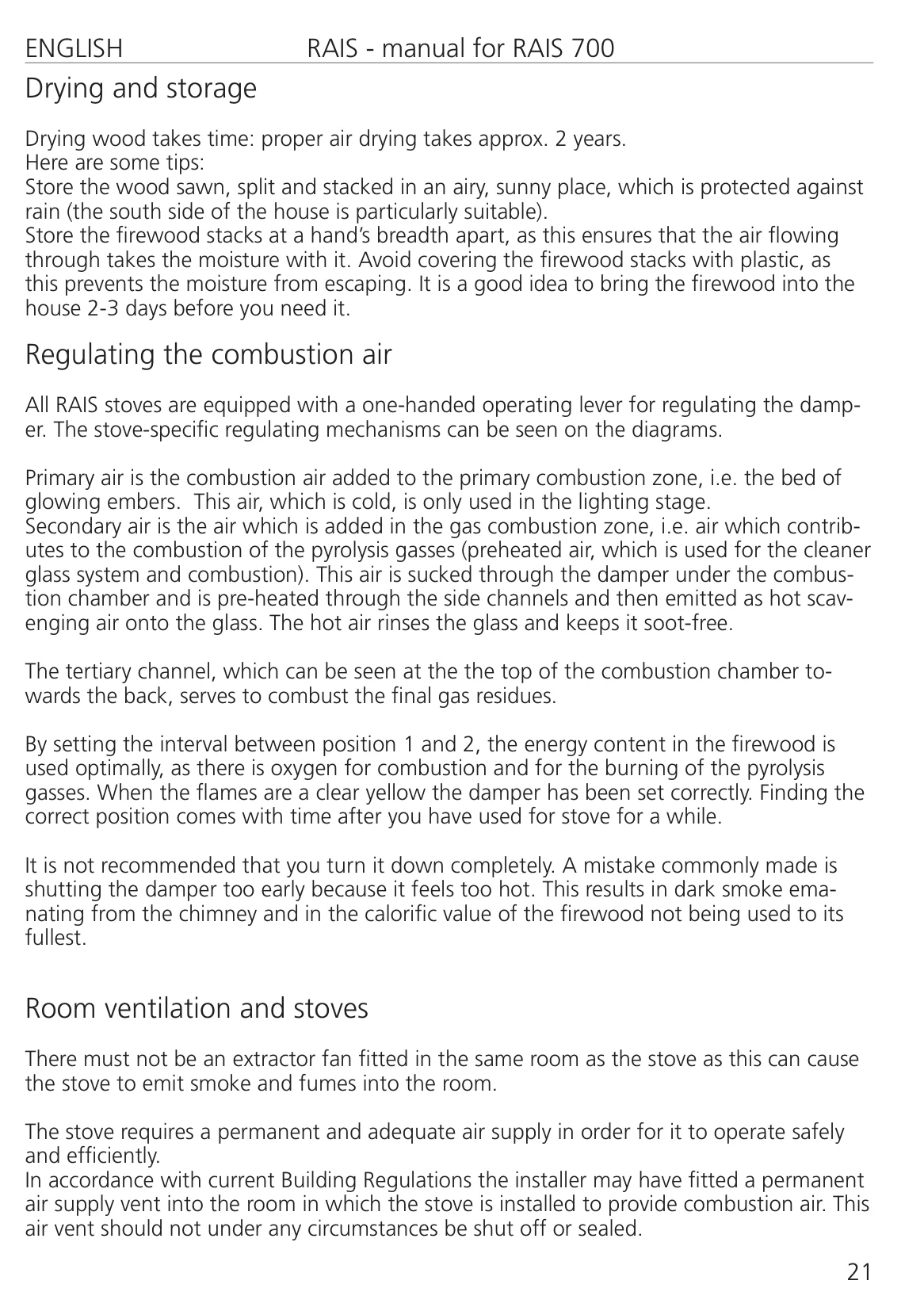
If the firewood is only burning slowly without flames or is smoking, and too little air is
added, unburned exhaust gasses are developed.
Exhaust gasses can be ignited and explode, leading to damage to material and possibly
personal injury.
Never close the air supply completely when lighting a fire
in the stove.
Sample photos
If there are only a few embers
remaining,
you must rekindle the fire.
If you simply add firewood, the fire will not
be lit, instead, unburned exhaust gasses
will
develop.
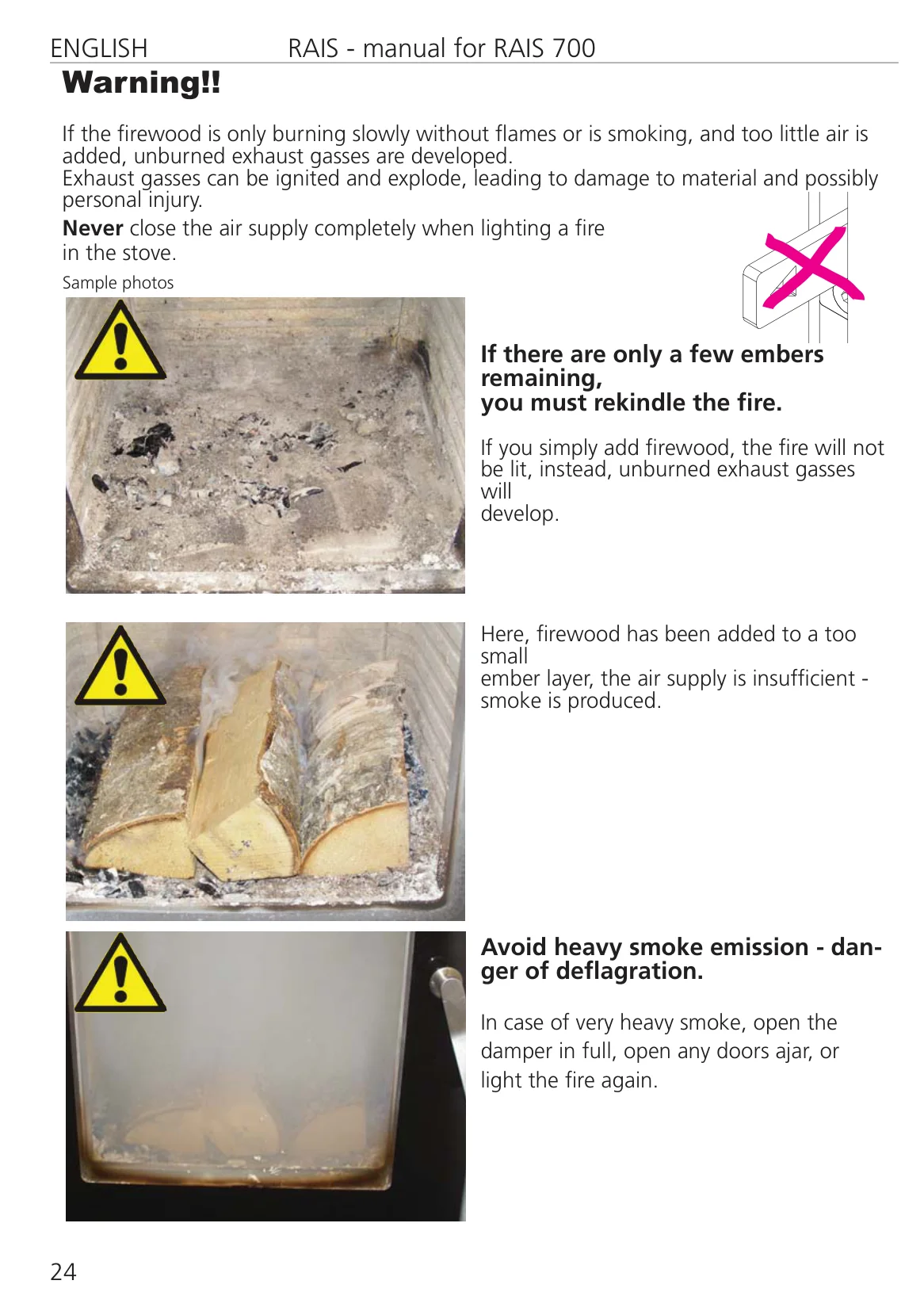
Here, firewood has been added to a too
small
ember layer, the air supply is insufficient -
smoke is produced.
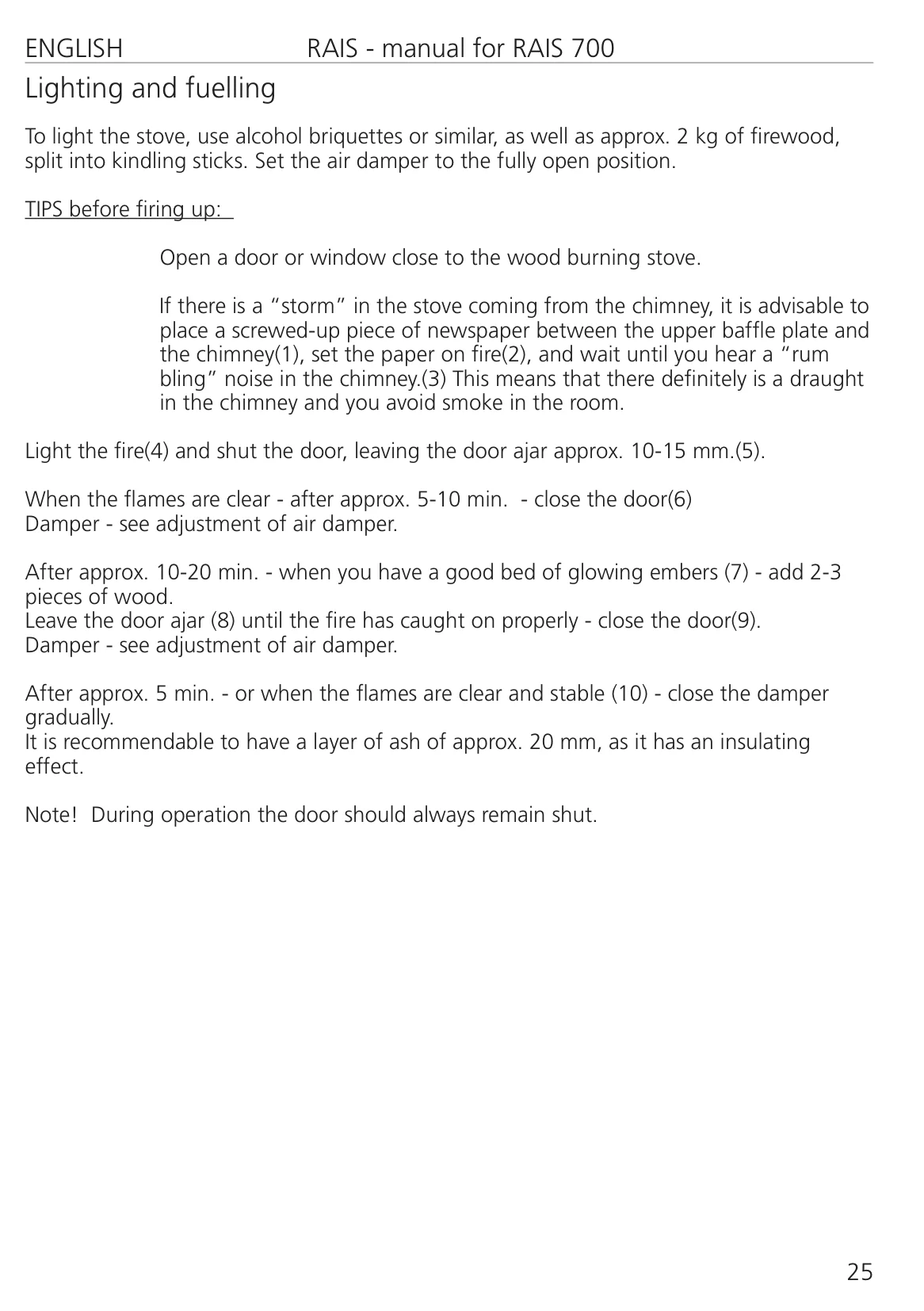
Avoid heavy smoke emission - dan
ger of deflagration.
In case of very heavy smoke, open the
damper in full, open any doors ajar, or
light the fire again.
ENGLISH RAIS - manual for RAIS 700
25
Lighting and fuelling
To light the stove, use alcohol briquettes or similar, as well as approx. 2 kg of firewood,
split into kindling sticks. Set the air damper to the fully open position.
TIPS before firing up:
Open a door or window close to the wood burning stove.
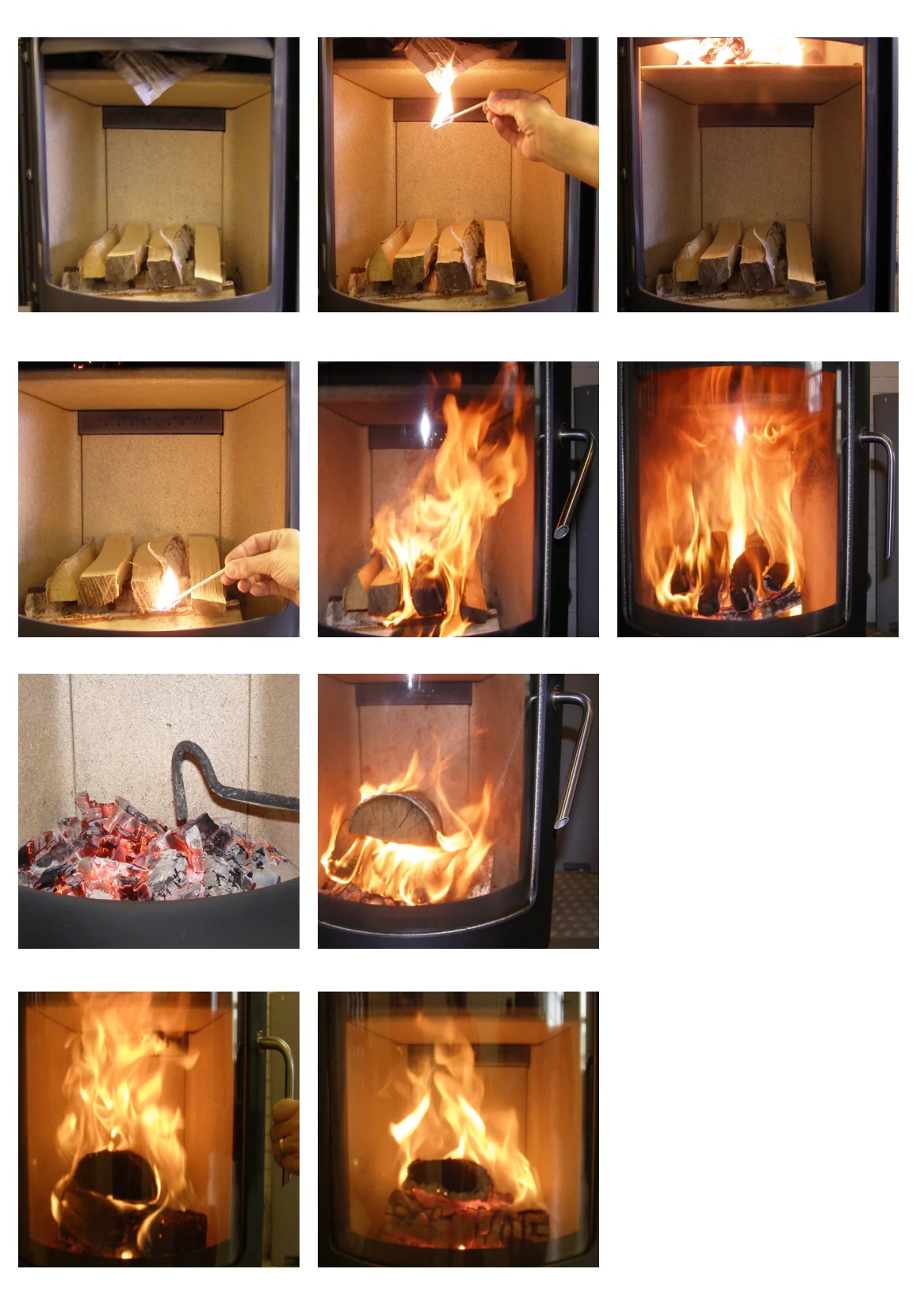
If there is a “storm” in the stove coming from the chimney, it is advisable to
place a screwed-up piece of newspaper between the upper baffle plate and
the chimney(1), set the paper on fire(2), and wait until you hear a “rum
bling” noise in the chimney.(3) This means that there definitely is a draught
in the chimney and you avoid smoke in the room.
Light the fire(4) and shut the door, leaving the door ajar approx. 10-15 mm.(5).
When the flames are clear - after approx. 5-10 min. - close the door(6)
Damper - see adjustment of air damper.
After approx. 10-20 min. - when you have a good bed of glowing embers (7) - add 2-3
pieces of wood.
Leave the door ajar (8) until the fire has caught on properly - close the door(9).
Damper - see adjustment of air damper.
After approx. 5 min. - or when the flames are clear and stable (10) - close the damper
gradually.
It is recommendable to have a layer of ash of approx. 20 mm, as it has an insulating
effect.
Note! During operation the door should always remain shut.
ENGLISH
RAIS - manual for RAIS 700
26
Cleaning and care
The wood burning stove and the chimney must be serviced by a chimney sweep twice a
year. During cleaning and care, the stove must be cold.
If the glass is sooty:
- Moisten a piece of paper or newspaper, dip it in the ash, and rub the sooty glass with
it.
- Now rub with a piece of paper and the glass will become clean.
- As an alternative you can use glass polish, which you can buy from you RAIS distributor.
Clean the exterior with a dry sponge.
Cleaning the combustion chamber:
Scrape/shovel the ash out and store it in a non-flammable container until it has cooled
down. You can dispose of ash with your normal household waste.
REMEMBER!! Never remove all the ashes from the combustion chamber - the wood
will burn at its best with a layer of ashes of approx. 20 mm.
Prolonged periodes of non-use:
If the stove is to be left unused for a prolonged period of time then it should be given
a thorough clean to remove ash and unburned fuel residues. To enable a good flow of
air through the appliance to reduce condensation and subsequent damage, leave the air
controls fully open.
Prior to a new heating season, it should be checked that the chimney and smoke gas con
nector are not blocked.
ENGLISH RAIS - manual for RAIS 700
27
Cleaning of the flue ways
The flue ways are consist of a baffle plate and a smoke
conductor above. This parts are screwed together.
Both parts are made of vermaculit.
Handle these parts carefully.
Lift the baffle plate a little and push towards one of the
sides.
Remove the baffleplate by lifting it upwards and tilting
on end.
Gently take out the baffle plate.
Now there is a clear view of the smoke exit.
Remove dirt and dust and put the parts back in reverse
order.
NB!
Make sure that the baffleplate are on a level with the
hole in the backside of the stove.
ENGLISH
RAIS - manual for RAIS 700
28
Interruption of operation
Smoke spillage around door:
Could be due to too low draught in the chimney <12Pa
- Check whether the flue or chimney is blocked
- �check whether the extraction hood is switched on; if it is, switch it off and open a win
dow/door in the proximity of the stove for a short while.
Soot on glass:
Could be because the firewood is too wet.
- make sure that the stove is heated properly when firing up, prior to closing the door
Could be because the damper regulation is too low.
A stove burning too strong could be caused by:
- leak around the door seal
- chimney draught too large >22 Pa, draught control regulator should be installed.
A stove burning too weakly could be caused by:
- too little firewood
- too little air supply for room ventilation
- unclean smoke channels
- leaky chimney
- leakage between chimney and flue
If your stove continues to malfunction, we recommend that you contact your RAIS dis
tributor or chimney sweep.
IMPORTANT!! To ensure safe burning there must be clear yellow flames or clear embers
at all times. The firewood should not be smoldering. Therefore you should never com
pletely cut off the air supply.
WARNING!!
In case of chimney fire:
- shut off all air supply on the wood burning stove
- contact the fire department
- never attempt to put out fire with water!
- afterwards, you should ask your chimney sweeper to check the stove and chimney
ENGLISH RAIS - manual for RAIS 700
29
Accessories and spare parts
If spare parts other than those recommended by RAIS are used, the warranty is voided.
7101790 Air-system
70914Spec Special cover
7091301SV Special adapter
All replaceable parts can be bought as spare parts from your RAIS distributor.
See the following spare parts diagrams for the individual products.
Reservedelstegning RAIS 700
Pos. Antal Varenr.
Beskrivelse
1
1
7091401SORT
Complete cover
2
1 7092090
Steel door
3
1
7091090
Glass door
4
1
7092200
Fire brick set
5
1
7090990
Air damper
6
1
7090101MON
Convex box
7
1
7095500
Seal set
30
Français Manuel d’utilisateur pour les modéles RAIS 700
Le four est emballé dans l’emballage de récupération.
L’emballage doit être emporté selon la réglementation natio
nale concernant l’élimination des déchets.
Le verre ne peut pas être recyclé.
Le verre doit être jeté avec les déchets résiduels de la
céramique et de la porcelaine.
Le verre résistant à la chaleur a une température de fusion plus
élevé et ne peut donc pas être réutilisé.
Veillant à ce que le verre résistant à la chaleur ne finisse pas
parmi les produits repris, est une aide et une contribution im
portante à l’environnement.
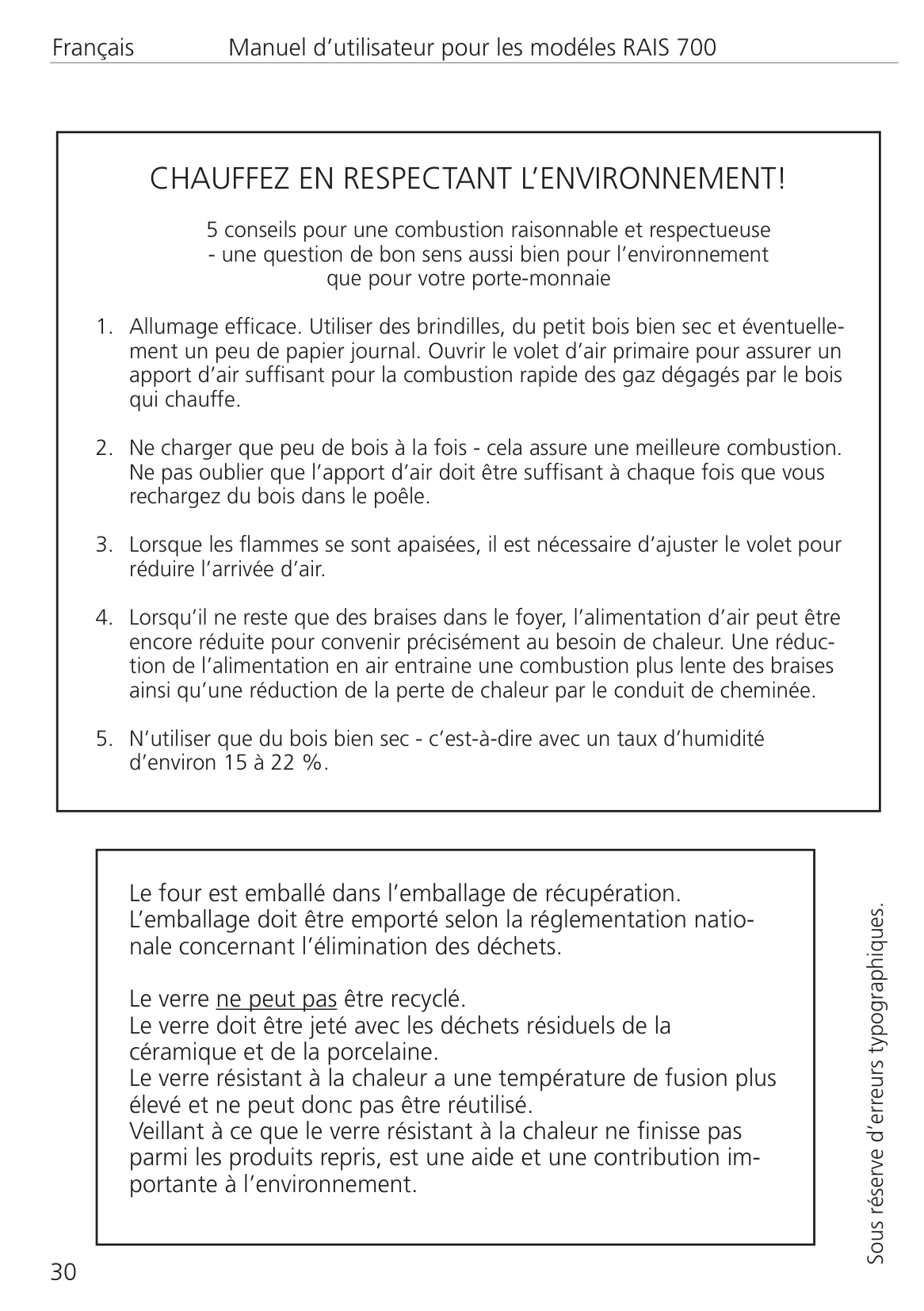
CHAUFFEZ EN RESPECTANT L’ENVIRONNEMENT!
5 conseils pour une combustion raisonnable et respectueuse
- une question de bon sens aussi bien pour l’environnement
que pour votre porte-monnaie
1. Allumage efficace. Utiliser des brindilles, du petit bois bien sec et éventuelle
ment un peu de papier journal. Ouvrir le volet d’air primaire pour assurer un
apport d’air suffisant pour la combustion rapide des gaz dégagés par le bois
qui chauffe.
2. Ne charger que peu de bois à la fois - cela assure une meilleure combustion.
Ne pas oublier que l’apport d’air doit être suffisant à chaque fois que vous
rechargez du bois dans le poêle.
3. Lorsque les flammes se sont apaisées, il est nécessaire d’ajuster le volet pour
réduire l’arrivée d’air.
4. Lorsqu’il ne reste que des braises dans le foyer, l’alimentation d’air peut être
encore réduite pour convenir précisément au besoin de chaleur. Une réduc
tion de l’alimentation en air entraine une combustion plus lente des braises
ainsi qu’une réduction de la perte de chaleur par le conduit de cheminée.
5. N’utiliser que du bois bien sec - c’est-à-dire avec un taux d’humidité
d’environ 15 à 22 %.
Sous réserve d’erreurs typographiques.
31
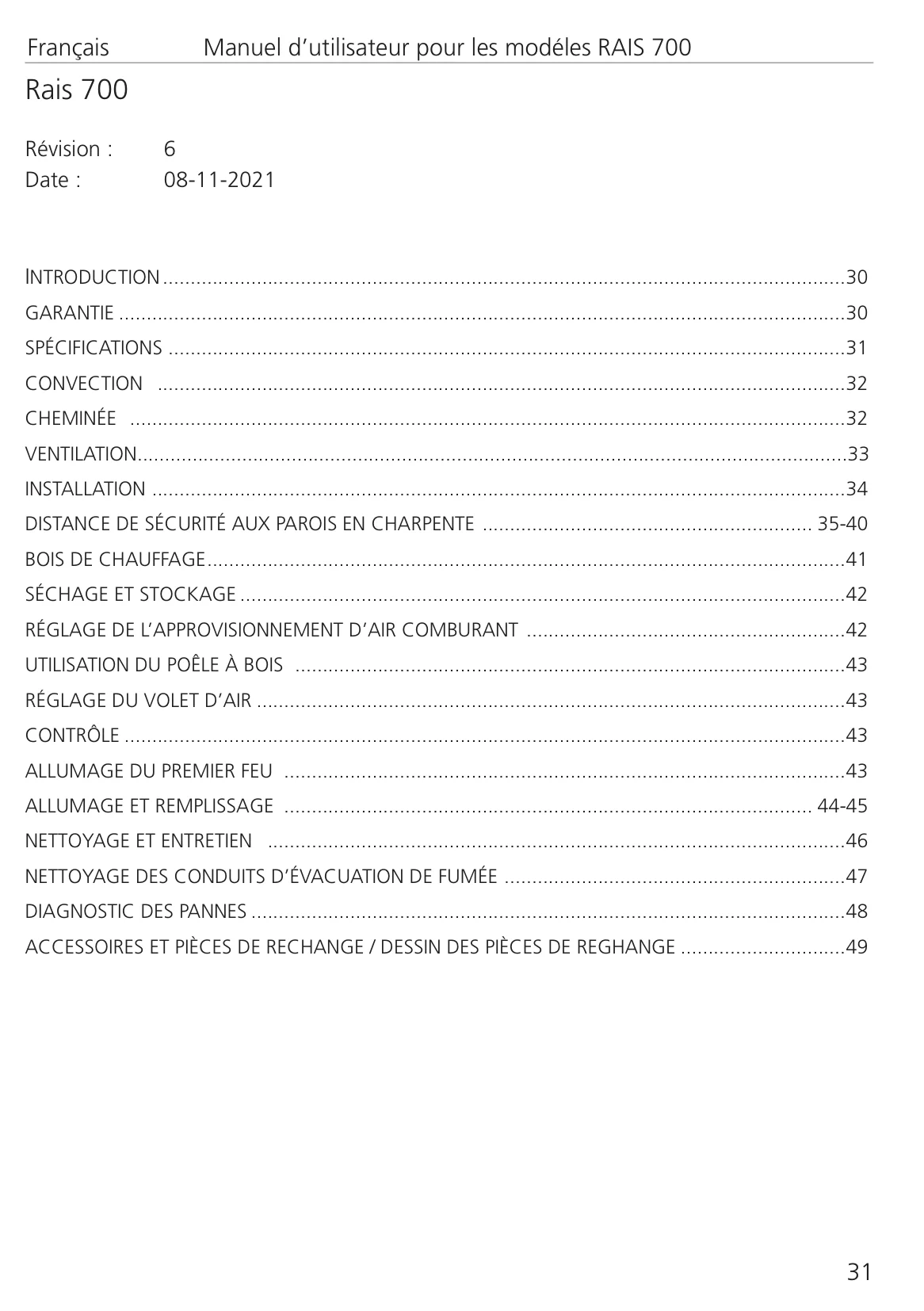
Français Manuel d’utilisateur pour les modéles RAIS 700
Rais 700
Révision :
6
Date :
08-11-2021
INTRODUCTION.............................................................................................................................30
GARANTIE.....................................................................................................................................30
SPÉCIFICATIONS ...........................................................................................................................31
CONVECTION ..............................................................................................................................32
CHEMINÉE ...................................................................................................................................32
VENTILATION.................................................................................................................................33
INSTALLATION ..............................................................................................................................34
DISTANCE DE SÉCURITÉ AUX PAROIS EN CHARPENTE ............................................................ 35-40
BOIS DE CHAUFFAGE....................................................................................................................41
SÉCHAGE ET STOCKAGE...............................................................................................................42
RÉGLAGE DE L’APPROVISIONNEMENT D’AIR COMBURANT ...........................................................42
UTILISATION DU POÊLE À BOIS ....................................................................................................43
RÉGLAGE DU VOLET D’AIR............................................................................................................43
CONTRÔLE....................................................................................................................................43
ALLUMAGE DU PREMIER FEU ......................................................................................................43
ALLUMAGE ET REMPLISSAGE ................................................................................................. 44-45
NETTOYAGE ET ENTRETIEN ..........................................................................................................46
NETTOYAGE DES CONDUITS D’ÉVACUATION DE FUMÉE ..............................................................47
DIAGNOSTIC DES PANNES.............................................................................................................48
ACCESSOIRES ET PIÈCES DE RECHANGE / DESSIN DES PIÈCES DE REGHANGE...............................49
32
Français Manuel d’utilisateur pour les modéles RAIS 700
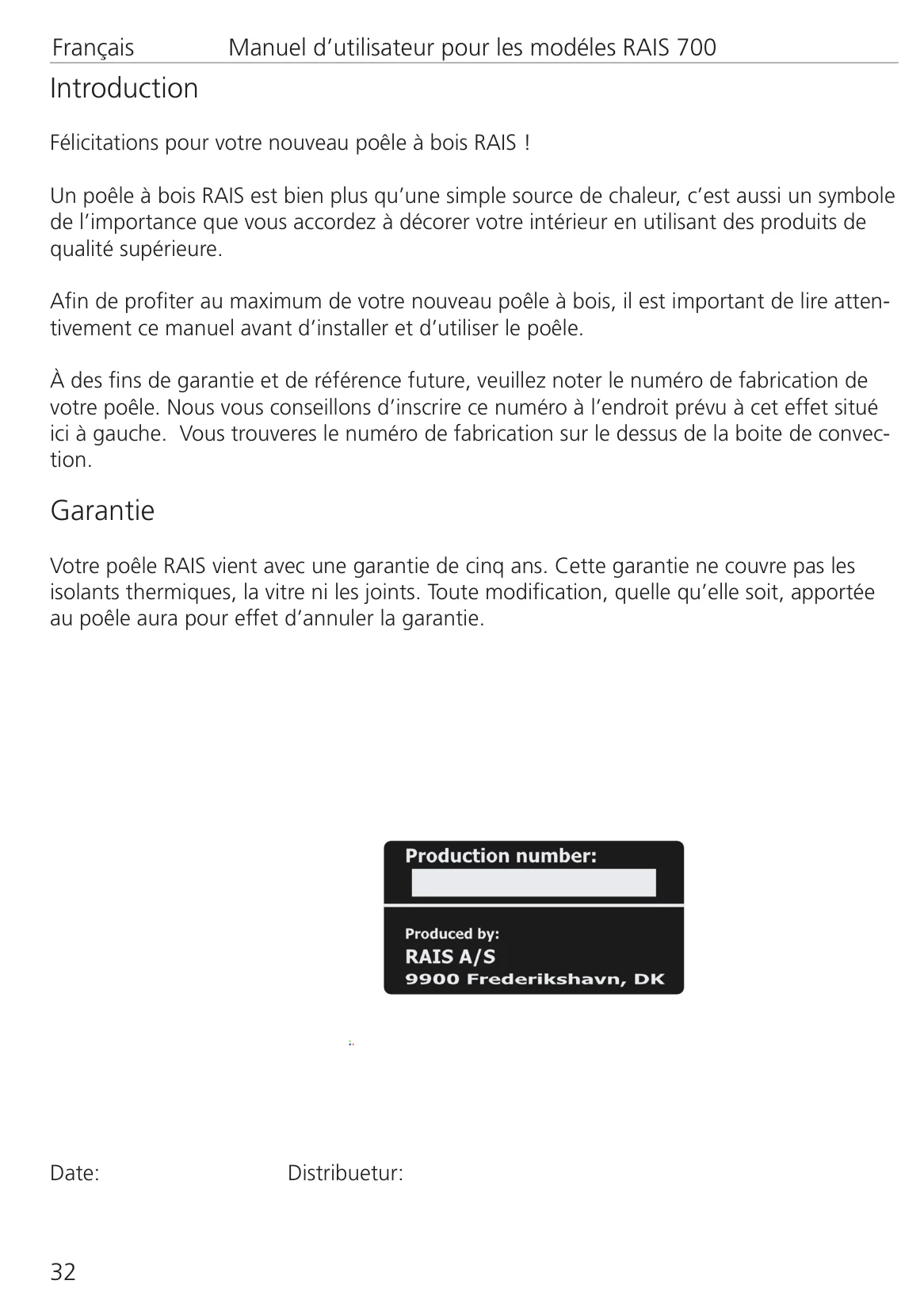
Introduction
Félicitations pour votre nouveau poêle à bois RAIS !
Un poêle à bois RAIS est bien plus qu’une simple source de chaleur, c’est aussi un symbole
de l’importance que vous accordez à décorer votre intérieur en utilisant des produits de
qualité supérieure.
Afin de profiter au maximum de votre nouveau poêle à bois, il est important de lire atten
tivement ce manuel avant d’installer et d’utiliser le poêle.
À des fins de garantie et de référence future, veuillez noter le numéro de fabrication de
votre poêle. Nous vous conseillons d’inscrire ce numéro à l’endroit prévu à cet effet situé
ici à gauche. Vous trouveres le numéro de fabrication sur le dessus de la boite de convec
tion.
Garantie
Votre poêle RAIS vient avec une garantie de cinq ans. Cette garantie ne couvre pas les
isolants thermiques, la vitre ni les joints. Toute modification, quelle qu’elle soit, apportée
au poêle aura pour effet d’annuler la garantie.
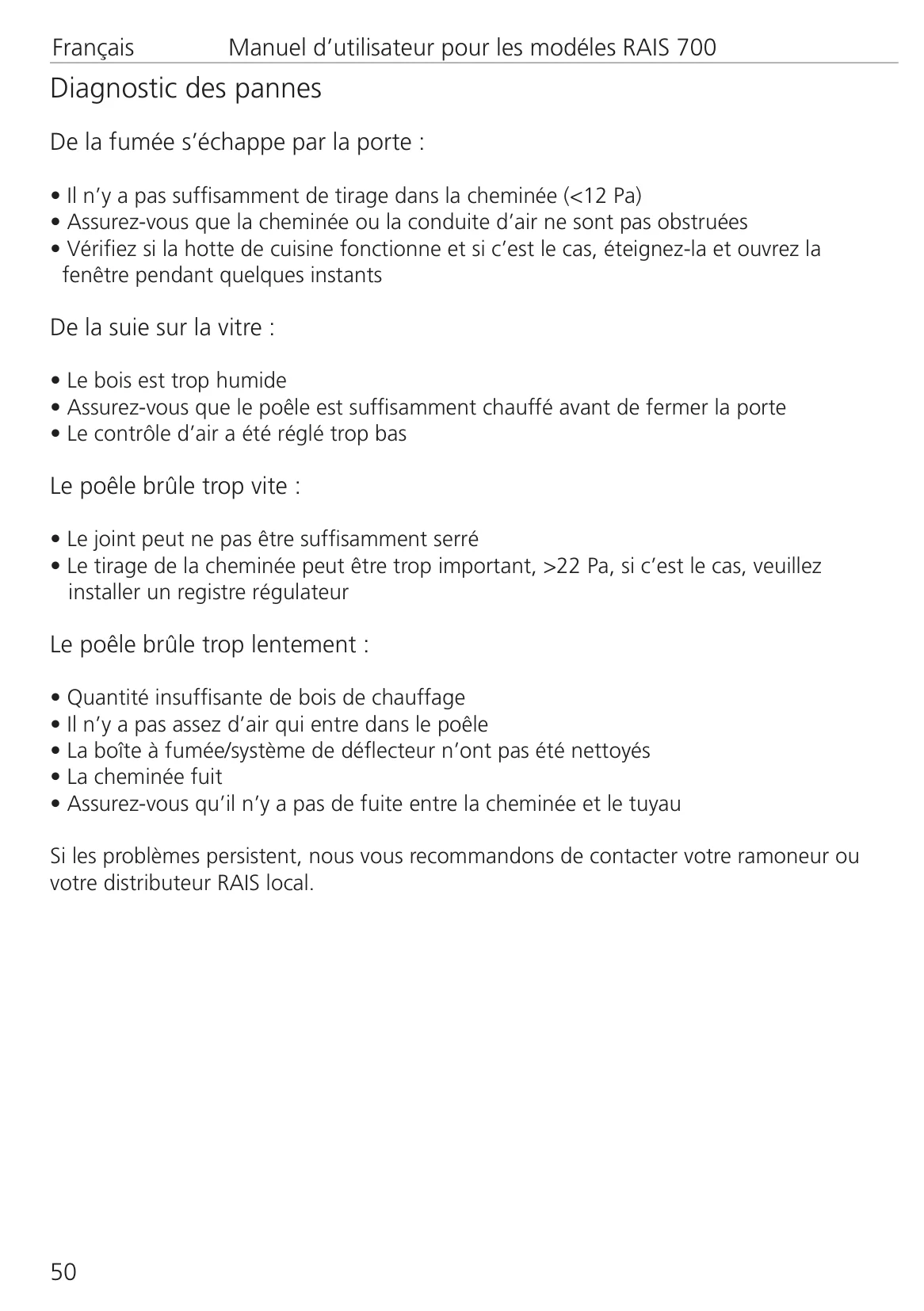
Date:
Distribuetur:
33
Français Manuel d’utilisateur pour les modéles RAIS 700
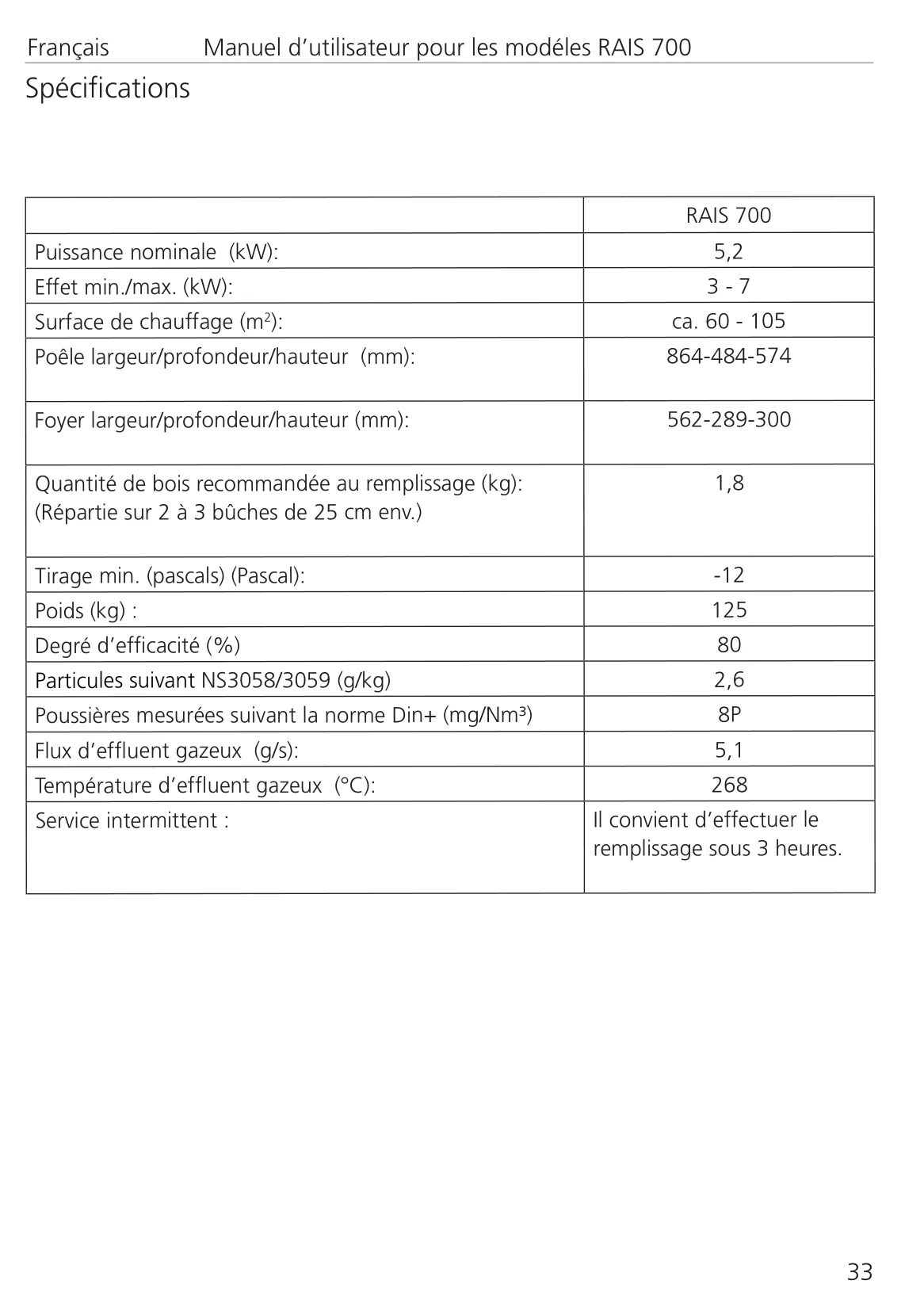
Spécifications
RAIS 700
Puissance nominale (kW):
5,2
Effet min./max. (kW):
3 - 7
Surface de chauffage (m2):
ca. 60 - 105
Poêle largeur/profondeur/hauteur (mm):
864-484-574
Foyer largeur/profondeur/hauteur (mm):
562-289-300
Quantité de bois recommandée au remplissage (kg):
(Répartie sur 2 à 3 bûches de 25 cm env.)
1,8
Tirage min. (pascals) (Pascal):
-12
Poids (kg) :
125
Degré d’efficacité (%)
80
Particules suivant NS3058/3059 (g/kg)
2,6
Poussières mesurées suivant la norme Din+ (mg/Nm³)
8P
Flux d’effluent gazeux (g/s):
5,1
Température d’effluent gazeux (°C):
268
Service intermittent :
Il convient d’effectuer le
remplissage sous 3 heures.
34
Français Manuel d’utilisateur pour les modéles RAIS 700
Convection
Tous les poêles RAIS sont des poêles à convection, ce qui veut dire que les parois latérales
du poêle ne deviennent jamais trop chaudes. Le principe de convection consiste à faire
entrer de l’air froid dans le système à la base du poêle et à le faire monter à travers le con
duit de convection situé le long de la chambre de combustion du poêle. L’air chauffé est
libéré par le dessus du poêle, créant ainsi une rapide circulation d’air dans la pièce.
Les poêles RAIS sont équipés de poignées refroidies par l’air, une spécialité RAIS, ce qui
veut dire que la poignée de votre poêle peut être touchée sans gant, quelle que soit la
température du poêle. Veuillez noter qu’il faut toujours être très prudent lorsqu’on touche
n’importe quelle partie du poêle tant que celui-ci est encore chaud.
Cheminée
La cheminée est le moteur de votre poêle. Même le meilleur poêle ne fonctionnera pas de
manière optimale si le tirage correct et nécessaire de la cheminée n’est pas disponible et si
la cheminée n’est pas correctement installée.
La cheminée doit être suffisamment haute (un minimum de 3 m) pour assurer le tirage
correct de 14-18 pascals. Lorsque le tirage recommandé ne peut pas être atteint, il peut
alors arriver que de la fumée sorte par la porte du poêle pour se répandre dans la pièce au
moment où on alimente le feu.
Faites très attention au tirage si vous utilisez une cheminée à double conduit.
Les poêles RAIS sont faits pour être installés avec un raccord de fumée, mais nous recom
mandons de placer des insertions avec un minimum de 250 mm entre.
La buse a un diamètre de 150 mm.
Si le tirage est trop important, il est recommandé d’installer un registre régulateur dans la
cheminée ou le tuyau de fumée. Dans le cas où un registre est installé, celui-ci doit avoir
une zone de circulation d’air d’au moins 20 cm² en position fermée. Cela garantit que la
valeur énergétique du bois de chauffage est utilisée de manière optimale. Si vous avez des
questions ou des inquiétudes concernant l’état de votre cheminée, veuillez contacter votre
ramoneur ou distributeur RAIS local.
Pensez à assurer un accès facile à la porte de ramonage de la cheminée.
35
Français Manuel d’utilisateur pour les modéles RAIS 700
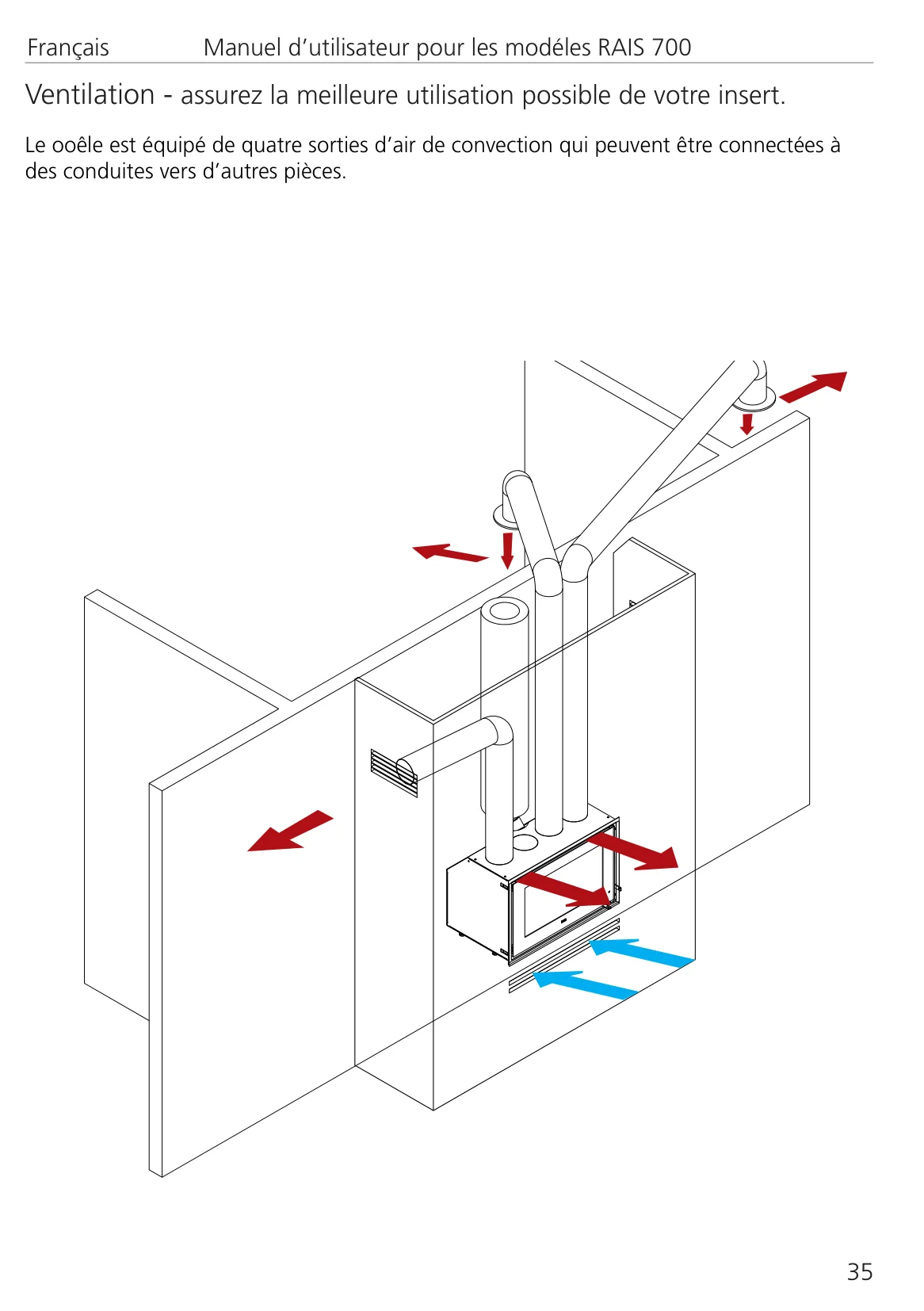
Ventilation - assurez la meilleure utilisation possible de votre insert.
Le ooêle est équipé de quatre sorties d’air de convection qui peuvent être connectées à
des conduites vers d’autres pièces.
36
Français Manuel d’utilisateur pour les modéles RAIS 700
Installation
Les règles suivantes doivent être respectées avant et pendant l’installation :
Le poêle doit être installé conformément aux codes et règlements de construction nation
aux et locaux. De plus, nous vous recommandons de contacter les autorités locales de
même qu’un ramoneur avant l’installation.
Aucune modification non autorisée ne doit être apportée au poêle.
REMARQUE : L’installation devrait être signalée au ramoneur local avant d’utiliser le
poêle.
Afin d’assurer une combustion efficace, il est important que la pièce dans laquelle le poêle
va être installé soit suffisamment alimentée en air frais.
Veuillez noter qu’une ventilation mécanique, telle qu’une hotte de cuisine, peut réduire
l’alimentation d’air.
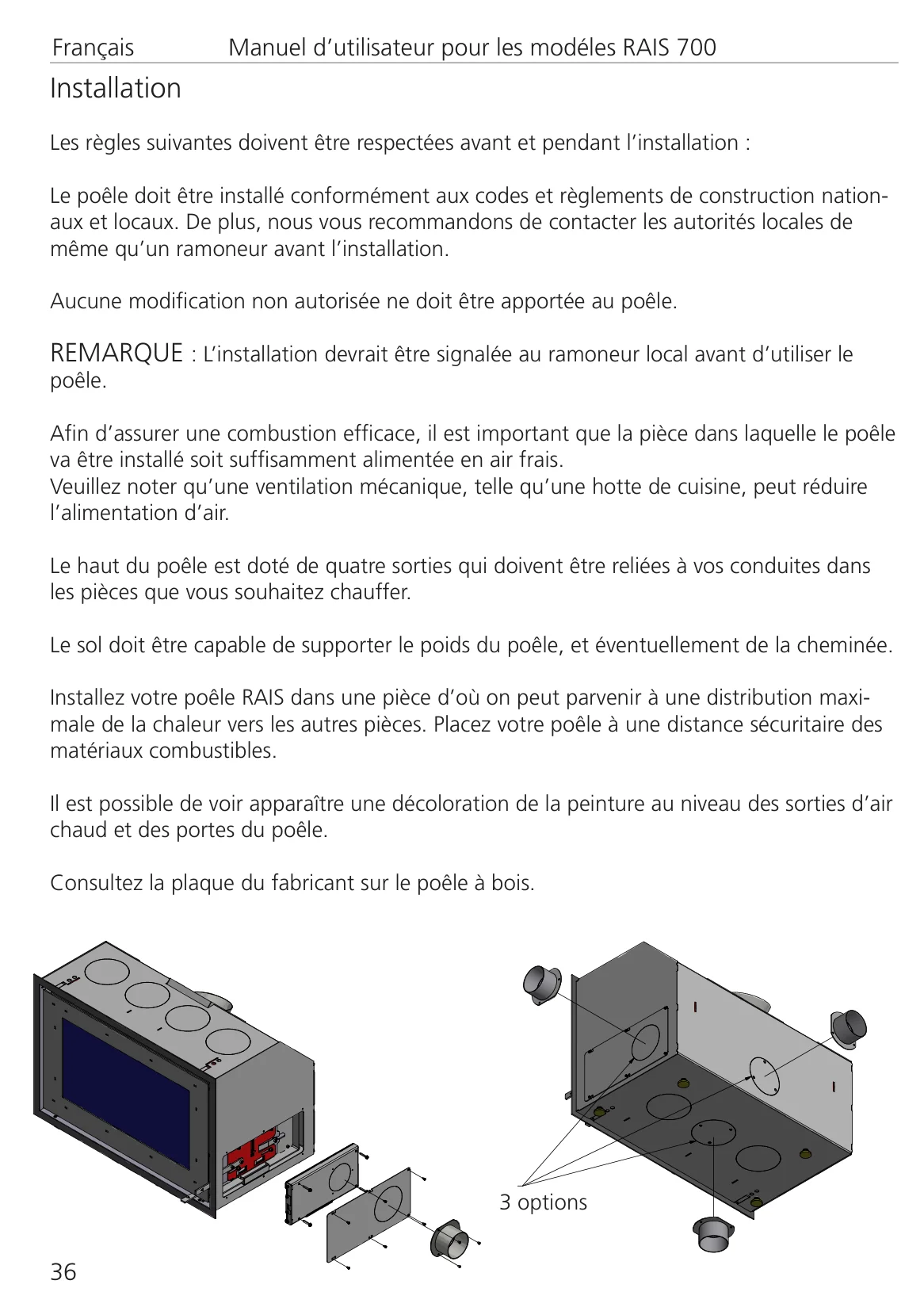
Le haut du poêle est doté de quatre sorties qui doivent être reliées à vos conduites dans
les pièces que vous souhaitez chauffer.
Le sol doit être capable de supporter le poids du poêle, et éventuellement de la cheminée.
Installez votre poêle RAIS dans une pièce d’où on peut parvenir à une distribution maxi
male de la chaleur vers les autres pièces. Placez votre poêle à une distance sécuritaire des
matériaux combustibles.
Il est possible de voir apparaître une décoloration de la peinture au niveau des sorties d’air
chaud et des portes du poêle.
Consultez la plaque du fabricant sur le poêle à bois.
3 options
37
Français Manuel d’utilisateur pour les modéles RAIS 700
Montage du poêle :
REMARQUE : Vous devez être attentif au positionnement des orifices d’entrée et
de sortie du système de convection. Veillez à respecter les exigences
en matière de taille/surface.
Une décoloration du mur peut se manifester au niveau des portes du
poêle et des orifices du système de convection. Ceci est dû aux montées
d’air chaud.
RAIS décline toute responsabilité pour le montage et les dommages qui y
seraient liés.
Veuillez inspecter le poêle à sa réception pour vous assurer qu’il ne présente pas de dé
fauts.
Retirez le poêle de la palette et amenez-le à l’emplacement de votre choix sur un support
adapté. Les pieds fournis correspondent à la hauteur d’installation minimale. Si vous sou
haitez installer le poêle plus haut, vous pouvez utiliser des pieds réglables (les accessoires
sont disponibles auprès de votre revendeur RAIS).
Mettez le poêle à niveau à l’aide des vis de réglage, de manière à ce que le bord supérieur
de la vitre soit horizontal en position fermée, et que la surface de la vitre soit verticale en
position fermée.
Démontez les portes et les panneaux de parement. Soyez particulièrement attentifs au
verre des portes : il est sensible aux coups et aux chocs. Laissez en place l’adhésif de
protection sur la poignée du registre. Protégez les surfaces peintes du poêle contre les
projections de ciment et de peinture.
Montez la partie non isolée de la cheminée sur le conduit de fumée dans le boîtier de con
vection. L’étanchéité doit être parfaite entre le conduit de fumée et le poêle. Nous con
seillons donc d’étanchéifier avec un joint ou une garniture au moment du raccordement.
Montez la partie isolée de la cheminée et reliez-la au besoin à une cheminée maçonnée.
Au besoin, montez la conduite d’air frais sur l’arrivée d’air sous le poêle.
Si vous choisissez de monter des tuyaux sur les sorties du système de convection, il vaut
mieux le faire avant d’encastrer le poêle.
Le poêle est prêt à être encastré dans la paroi en bois ou maçonnée.
Une fois le mur terminé et éventuellement peint, montez les panneaux de parement et les
portes du poêle.
Les panneaux de parement sont réglés par défaut sur une épaisseur de paroi maximale.
Desserrez les vis en haut et en bas. Poussez les panneaux vers le mur. Vérifiez que le pan
neau de parement est bien parallèle au mur et à la surface vitrée de la porte en position
fermée, ajustez le panneau au besoin.
Il est possible de commander un panneau de parement sur mesure. Pour cela, veuillez con
tacter votre revendeur RAIS. Le panneau peut être commandé en même temps que le poêle.
Instructions de montage
38
Français Manuel d’utilisateur pour les modéles RAIS 700
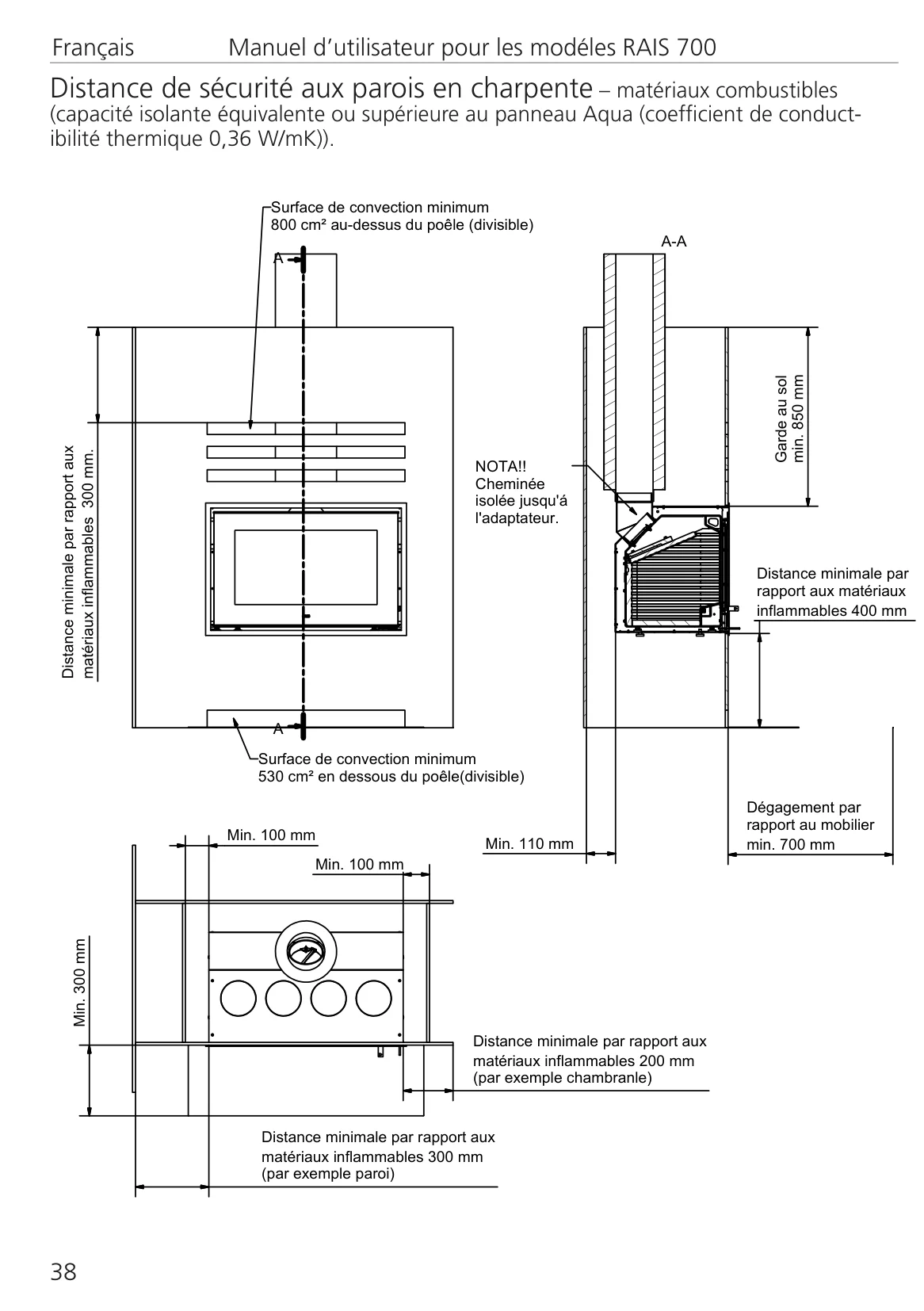
Distance de sécurité aux parois en charpente – matériaux combustibles
(capacité isolante équivalente ou supérieure au panneau Aqua (coefficient de conduct
ibilité thermique 0,36 W/mK)).
A-A
AA
110
Min.
mm
850
min.
mm
Garde au sol
400
inflammables
mm
Distance minimale par
rapport aux matériaux
300
matériaux inflammables
mm
Distance minimale par rapport aux
(par exemple paroi)
200
matériaux inflammables
mm
Distance minimale par rapport aux
(par exemple chambranle)
100
Min.
mm
100
Min.
mm
300
Min.
mm
Surface de convection minimum
800 cm² au-dessus du poêle (divisible)
Surface de convection minimum
530 cm² en dessous du poêle(divisible)
300
matériaux inflammables
mm.
Distance minimale par rapport aux
NOTA!!
Cheminée
isolée jusqu'á
l'adaptateur.
700
min.
mm
Dégagement par
rapport au mobilier
39
Français Manuel d’utilisateur pour les modéles RAIS 700
A-A
AA
110
Min.
mm
850
min.
mm
Garde au sol
400
inflammables
mm
Distance minimale par
rapport aux matériaux
300
matériaux inflammables
mm
Distance minimale par rapport aux
(par exemple paroi)
200
matériaux inflammables
mm
Distance minimale par rapport aux
(par exemple chambranle)
100
Min.
mm
100
Min.
mm
300
Min.
mm
Surface de convection minimum
800 cm² au-dessus du poêle (divisible)
Surface de convection minimum
530 cm² en dessous du poêle(divisible)
300
matériaux inflammables
mm.
Distance minimale par rapport aux
NOTA!!
Cheminée
isolée jusqu'á
l'adaptateur.
700
min.
mm
Dégagement par
rapport au mobilier
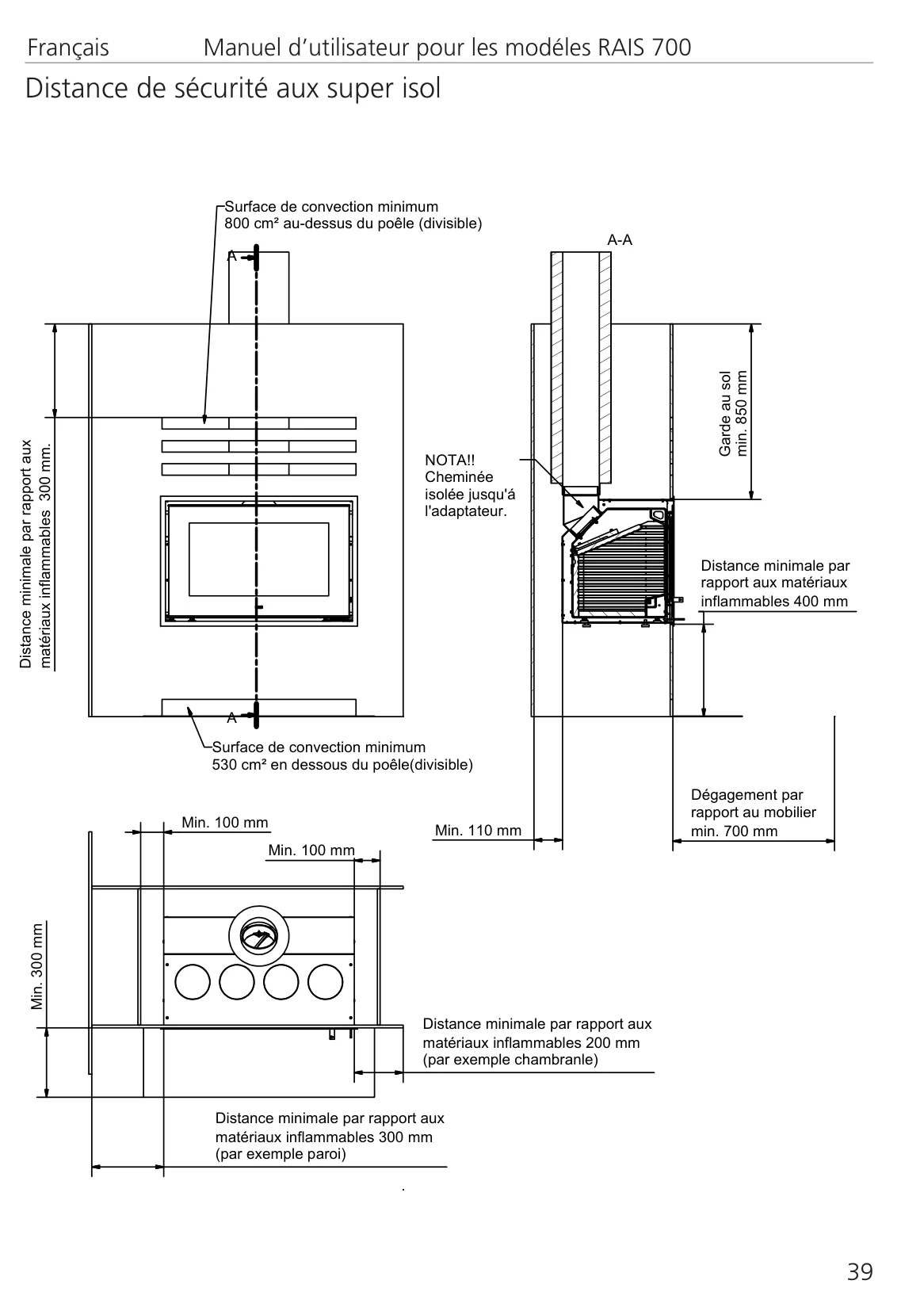
Distance de sécurité aux super isol
40
Français Manuel d’utilisateur pour les modéles RAIS 700
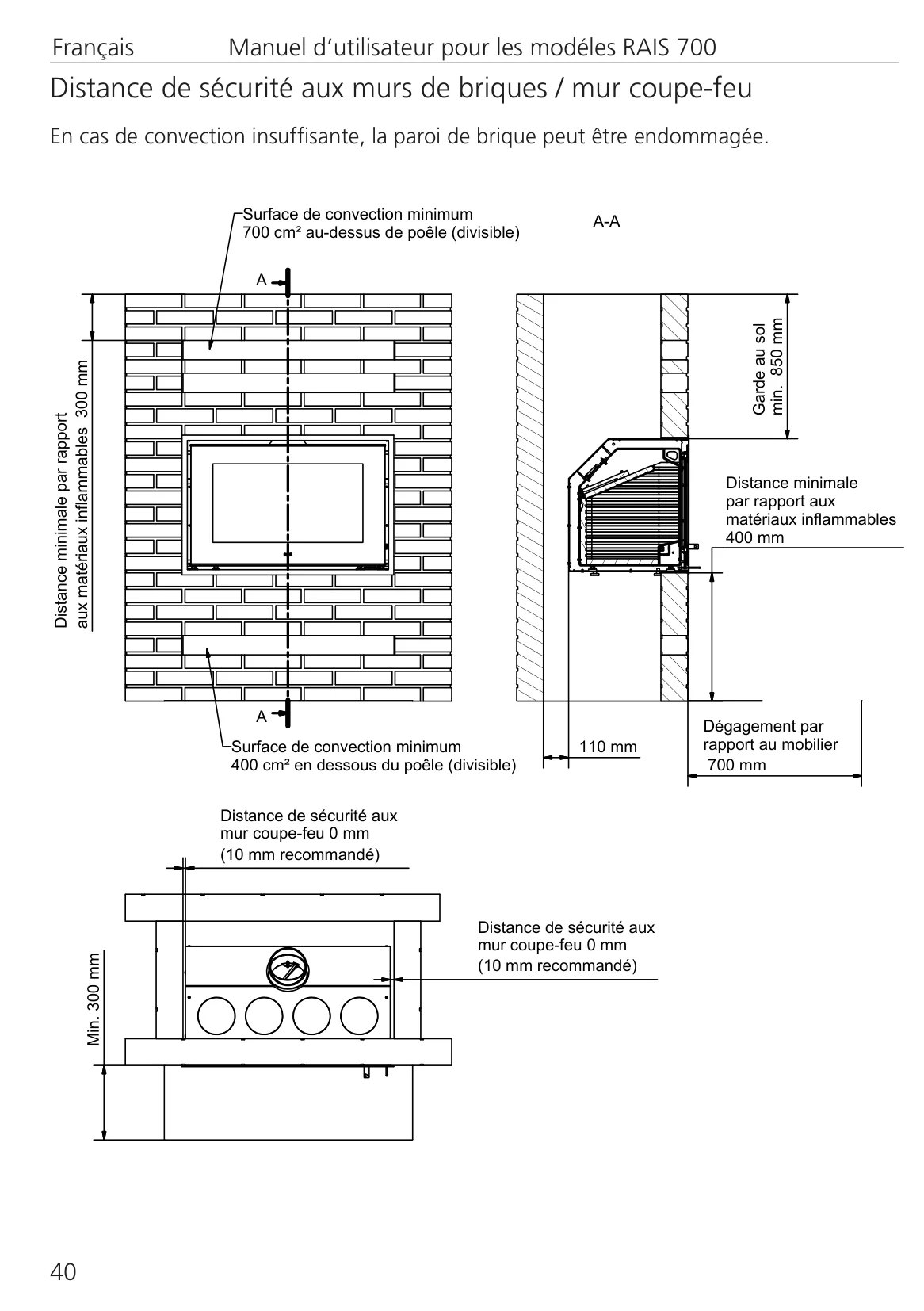
Distance de sécurité aux murs de briques / mur coupe-feu
En cas de convection insuffisante, la paroi de brique peut être endommagée.
A-A
AA
110 mm
700
mm
Dégagement par
rapport au mobilier
400
Distance minimale
par rapport aux
matériaux inflammables
mm
850
min.
mm
Garde au sol
300
aux matériaux inflammables
mm
Distance minimale par rapport
0
mur coupe-feu mm
Distance de sécurité aux
(10 mm recommandé)
0
mur coupe-feu mm
Distance de sécurité aux
(10 mm recommandé)
300
Min.
mm
Surface de convection minimum
700 cm² au-dessus de poêle (divisible)
Surface de convection minimum
400 cm² en dessous du poêle (divisible)
41
Français Manuel d’utilisateur pour les modéles RAIS 700
Aqua panneau
Super isol
Murs de briques
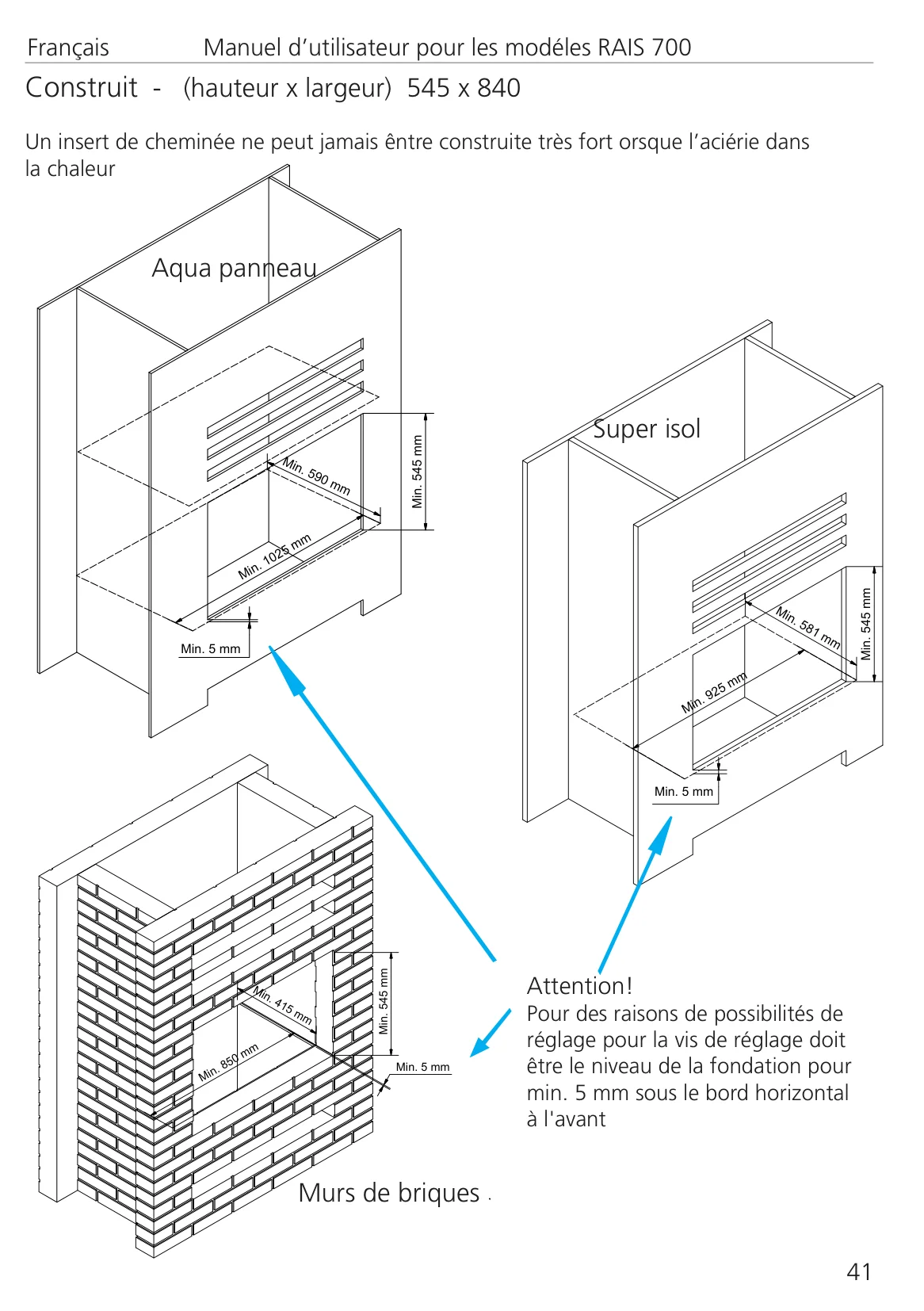
Construit - (hauteur x largeur) 545 x 840
Un insert de cheminée ne peut jamais êntre construite très fort orsque l’aciérie dans
la chaleur
Attention!
Pour des raisons de possibilités de
réglage pour la vis de réglage doit
être le niveau de la fondation pour
min. 5 mm sous le bord horizontal
à l'avant
545
Min.
mm
850
Min.
mm
415
Min.
mm
5
Min. mm
1025
Min.
mm
590
Min.
mm
545
Min.
mm
5
Min. mm
581
Min.
mm
925
Min.
mm
545
Min.
mm
5
Min. mm
42
Français Manuel d’utilisateur pour les modéles RAIS 700
AA
864
782
489
574
127 191,7
191,7
191,7 127
n150
n147
203
A-A
403
461
45°
541
548
43
Français Manuel d’utilisateur pour les modéles RAIS 700
Bois de chauffage
Votre poêle RAIS a été conçu et agréé conformément à la certification EN pour la com
bustion de bois de chauffage coupé et séché. Le bois de chauffage ne devrait contenir
que 15-22% d’eau et avoir une longueur maximum d’environ 28 cm ou la largeur de la
chambre de combustion moins 50-60 mm. Brûler du bois de chauffage humide n’est pas
économique et crée de la suie en plus de causer d’autres problèmes environnementaux.
Le bois nouvellement coupé contient approximativement 60-70% d’humidité et il est par
conséquent inutile de l’utiliser comme matériau de chauffage. Le bois coupé doit être
stocké pendant au moins deux ans avant d’être utilisé comme combustible.
Le bois de chauffage qui a un diamètre dépassant 100 mm devrait être divisé et quelle
que soit la taille du bois, sa surface doit être dépourvue d’écorce.
N’utilisez pas de bois traité ou peint, de bois lamellé, de bois avec un recouvrement ar
tificiel, de contreplaqué, de charbon, de briquettes en papier, ni de déchets (le plastique
et autres types de matériaux artificiels dégagent des gaz nocifs) comme combustible
dans votre poêle à bois RAIS. Si de tels matériaux ou une plus grande quantité de bois de
chauffage que celle recommandée sont utilisés, votre poêle sera alors exposé à une trop
forte chaleur, laquelle conduira à des températures élevées dans la cheminée avec pour
résultat une efficacité réduite. De plus, votre poêle et votre cheminée pourraient tous les
deux être endommagés et votre garantie sera annulée. La capacité du bois de chauff
age à bien brûler est étroitement liée à la quantité d’humidité présente dans le bois de
chauffage. Un taux élevé d’humidité résultera en une chaleur moins importante, car plus
il y aura déau dans le bois de chauffage, plus il audra utiliser d’énergie pour l’évaporer et
cette énergie sera donc perdue.
La valeur calorifique de différents types de bois qui ont été séchés pendant deux ans et
contiennent un taux d’humidité de 15-20% est indiquée dans le tableau ci-après :
Type de bois
Bois sec en kg/m³
Comparé au hêtre/chêne
Hêtre blanc
640
110 %
Hêtre et chêne 580
100 %
Frêne
570
98 %
Érable
540
93 %
Bouleau
510
88 %
Pin de montagne
480
83 %
Épinette
390
67 %
Peuplier
380
65 %
Tous les types de bois chauffent de la même manière par kg ; cependant, la densité du
bois n’est pas la même. Par exemple, 1 kg de bois d’hêtre prend moins de place qu’1 kg
d’épinette.
44
Français Manuel d’utilisateur pour les modéles RAIS 700
Séchage et stockage du bois
Cela prend du temps de faire sécher du bois et le bois de chauffage utilisé comme
matériau de chauffage doit avoir séché pendant au moins deux ans pour garantir une
combustion optimale. Au moment de faire votre réserve de bois de chauffage, coupez
et divisez d’abord le bois avant de le stocker, puis empilez-le dans un endroit aéré, sec et
ensoleillé, à l’abri de la pluie. Le côté sud de la maison convient habituellement bien à des
fins d’entreposage. Empilez le bois en veillant à laisser assez d’espace entre les rangées
afin d’assurer une bonne circulation d’air. Ne recouvrez pas les piles de bois de plastique,
car cela empêche le bois de sécher correctement. C’est aussi une bonne idée de rentrer les
bûches à l’intérieur deux à trois jours avant de les utiliser.
Réglage de l’approvisionnement d’air comburant
Tous les poêles RAIS sont pourvus d’un levier facile d’utilisation pour régler le contrôle
d’air. Pour les différentes positions du contrôle, voyez les illustrations.
L’air primaire est l’air qui est apporté dans la zone de combustion primaire, c.-à-d. la
couche de braises. Cet air, qui est froid, n’est seulement utilisé que durant la phase de
démarrage.
L’air secondaire assure la combustion des gaz à des températures élevées (air préchauffé
qui est utilisé pour le lavage à l’air et la combustion). Cet air arrive en passant par le
contrôle d’air situé en dessous de la chambre de combustion et est chauffé à travers les
buses latérales avant d’être ensuite dirigé vers la vitre. L’air chaud circule le long de la vitre,
empêchant ainsi la suie de s’y déposer.
À l’arrière de la chambre de combustion, se trouve au-dessus une buse tertiaire. Cet ap
provisionnement d’air tertiaire aide à brûler les gaz restants.
En positionnant le contrôle d’air entre la Position 1 et 2, on laisse entrer dans le poêle une
quantité d’oxygène suffisante pour la combustion, ce qui permet d’arriver à une utilisa
tion optimale du combustible. Le contrôle d’air est correctement réglé lorsque les flammes
sont jaunes et vives. Trouver la bonne position peut nécessiter quelques tâtonnements,
mais c’est facile à faire.
Il est recommandé de ne jamais fermer le contrôle d’air entièrement lorsqu’on utilise le
poêle. L’erreur classique est de fermer le contrôle d’air trop tôt, parce que la chaleur devi
ent trop intense. Cela a pour résultat l’apparition d’un sombre nuage de fumée provenant
de la cheminée et cela veut dire que la valeur énergétique du bois n’est pas correctement
utilisée.
45
Français Manuel d’utilisateur pour les modéles RAIS 700
Utilisation du poêle
Réglage du volet d’air. Le volet d’air possède 3 positions.
Position 1
Le volet d’air est quasiment fermé et l’alimentation d’air est minimale.
Position 2
Tirez sur la poignée jusqu’au premier déclic.
Cette position permet l’apport d’air secondaire.
Pour une combustion ordinaire, réglez la poignée dans l’intervalle entre 1 et 2.
Des flammes claires et jaunes signifient que le volet est bien réglé, c’est-à-dire que la com
bustion obtenue sera lente/optimale.
Position 3
Tirez sur la poignée jusqu’au déclic suivant. Le volet d’air est complètement ouvert et per
met l’arrivée d’air primaire et secondaire. Cette position convient uniquement à la phase
d’allumage et non au fonctionnement normal.
Contrôle
Si les cendres sont blanches et les parois du foyer ne sont pas enduites de suie après
l’usage du poêle, cela signifie que le réglage d’admission d’air a été correct et le bois suf
fisamment sec.
Allumage du premier feu
Commencez à utiliser votre nouveau poêle en douceur et vous en serez récompensé.
Commencez par un petit feu de sorte à habituer votre poêle aux températures élevées.
Cela lui garantira le meilleur départ possible et évitera d’éventuels dommages.
Lors des premiers feux, il se pourrait que vous détectiez une odeur étrange provenant des
effets de la chaleur sur la peinture et les matériaux. C’est normal et ce n’est que tempo
raire. Assurez-vous simplement qu’il y ait beaucoup d’air frais dans la pièce lorsque vous
démarrez le feu.
Durant ce processus, veuillez à ne pas toucher les surfaces peintes, et ouvrez et fermez
fréquemment la porte du poêle pour éviter que les joints de la porte ne collent.
De plus, durant la période initiale de chauffage et de refroidissement, il peut arriver que
le métal émette des bruits semblables à des cliquetis du fait d’être exposé à d’importantes
variations de température. Cela aussi est normal et ne durera pas.
N’utilisez jamais de combustible liquide quel qu’il soit pour allumer ou entretenir le feu car
il pourrait y avoir un risque d’explosion.
Lorsque le poêle n’a pas été utilisé depuis longtemps, utilisez la même approche que celle
recommandée dans le cas d’un premier feu.
46
Français Manuel d’utilisateur pour les modéles RAIS 700
Allumage et remplissage
Pour l’allumage, utilisez des blocs d’allumage ou aurte produit similaire et environ 2 kg de
bûchettes d’allumage fendues. Ouvrez complétement le registre.
CONSEILS avant l’allumage : (photo 1-2-3-4)
Ouvrez une porte ou une fenêtre, à proximité du poêle.
S’il y a un appel d’air dans le poêle en provenance de la cheminée, vous
pouvez mettre un papier de journal froissé entre le déflecteur et la cheminée.
Faites brûler le papier(2) et attendez qu’il se produise un ”grondement” dans
la cheminée(3). Vous serez ainsi sûr qu’il y a du tirage dans la cheminée et vous
éviterez que la fumée ne se propage dans la pièce.
Allumez le feu et laissez la porte entrouverte (env. 10 à 15 mm) (photo 4-5)
Lorsque le feu est clair, (après env. 5 à 10 min.), fermez la porte. (photo 6)
Registre - voir réglage du registre.
Après env. 10 à 20 min - lorsqu’une bonne couche de braise s’est formée (photo 7) - re
mettez du bois (environ 2 à 3 bûches).
Laissez la porte entrouverte jusqu’à ce que le feu ait bien pris (photo 8)
Fermez la porte. (photo 9)
Registre - voir réglage du registre.
Une fois que les flammes sont jaunes, claires et stables (env. 5 min plus tard), fermez pro
gressivement le registre. (photo 10)
Il est préférable qu’il y ait une couche de cendres d’env. 20 mm, puisque celles-ci ont un
effet isolant.
ATTENTION !
Pendant le fonctionnement, la porte doit toujours rester fermée.
47
Français Manuel d’utilisateur pour les modéles RAIS 700
AVERTISSEMENT!!
Si le bois ne fait que brûler sans flamme ou fume et il n’y pas suffisamment d’air, des gaz
de fumée non enflammés peuvent se développer.
Le gaz fumée peut être enflammé et exploser. Cela peut faire des dommages au matériel
et, au pis, aux personnes.
Ne fermez jamais pour l’alimentation en air lorsque vous allez
allumer votre cheminée.
S’il ne reste que quelques particules
non éteintes, vous devez allumer à
nouveau.
Si on ne met que du bois,
le feu ne sera pas allumé, mais par
contre des gaz de fumée non enflammés
seront développés.
Voici on a mis du bois sur une trop petite
couche de particules non éteintes en
même temps avec une alimentation en
air trop faible – le dégagement de fumé
commence à se développer.
Évitez le dégagement de fumé très
puissant – au risque d’une explosion
de gaz de fumée.
Au cas d’un dégagement de fumé très
puissant, ouvrez le volet d’obturation d’air
complétement et mettez aussi le portillon
entrebâillé ou allumer à nouveau.
48
Français Manuel d’utilisateur pour les modéles RAIS 700
Entretien
Vous devriez faire contrôler votre cheminée ainsi que votre poêle une fois par an par un
ramoneur professionnel. Durant le nettoyage, le contrôle ou la réparation, le poêle doit
être froid.
Si la vitre de la porte de votre poêle est recouverte de suie, humectez un morceau de
papier ou de journal, trempez-le dans les cendres froides et frottez la vitre recouverte de
suie. Utilisez ensuite un autre morceau de papier pour polir la vitre, et celle-ci sera à nou
veau propre. Autrement, vous pouvez utiliser un produit pour nettoyer les vitres en vente
chez votre distributeur RAIS.
Les surfaces extérieures peuvent être nettoyées à l’aide d’une éponge sèche.
Nettoyage de la chambre de combustion :
Remuez les braises pour faire tomber les cendres que vous gardez dans un récipient non
combustible jusqu’à ce qu’elles aient refroidi. Les cendres peuvent ensuite être jetées avec
les ordures ordinaires.
Rappelez-vous de ne JAMAIS nettoyer toutes les cendres de la chambre de combustion.
Pour une meilleure combustion, laissez une couche d’environ 20 mm.
La cheminée et les tuyaux de fumée devraient toujours être inspectés au début d’une nou
velle saison d’utilisation du poêle pour s’assurer que le passage de l’air n’est pas obstrué.
49
Français Manuel d’utilisateur pour les modéles RAIS 700
Nettoyage des conduits d’évacuation de fumée
Le dispositif d’evacuation de fumée consiste en une
plaque de déflection surmontée d’un duyau
d’èvacuation. Ces pièces, vissées ensemble, sont toutes
deux fabriquées en vermiculite. Maniezlez avec soins.
Soulevez légèrement la plaque de déflection puis
poussez-la vers le côté.
Enlevez la plaque de déflection den la soulevant et en la
faisant basculer sur l’extrémité.
Enlevez doucement la plaque de déflection.
Vous avez d´esormais accès à la sortie de fumée.
Supprimez la poussière et les saletés et replacez les
pièces en répétant les mêmes opérations dans le sens
inverse.
ATTENTION !
Assurez-vous que la plaque de déflection est bien
alignée de niveau avec l’orifice pratiqué à l’arrière du
poêle.
50
Français Manuel d’utilisateur pour les modéles RAIS 700
Diagnostic des pannes
De la fumée s’échappe par la porte :
• Il n’y a pas suffisamment de tirage dans la cheminée (<12 Pa)
• Assurez-vous que la cheminée ou la conduite d’air ne sont pas obstruées
• Vérifiez si la hotte de cuisine fonctionne et si c’est le cas, éteignez-la et ouvrez la
fenêtre pendant quelques instants
De la suie sur la vitre :
• Le bois est trop humide
• Assurez-vous que le poêle est suffisamment chauffé avant de fermer la porte
• Le contrôle d’air a été réglé trop bas
Le poêle brûle trop vite :
• Le joint peut ne pas être suffisamment serré
• Le tirage de la cheminée peut être trop important, >22 Pa, si c’est le cas, veuillez
installer un registre régulateur
Le poêle brûle trop lentement :
• Quantité insuffisante de bois de chauffage
• Il n’y a pas assez d’air qui entre dans le poêle
• La boîte à fumée/système de déflecteur n’ont pas été nettoyés
• La cheminée fuit
• Assurez-vous qu’il n’y a pas de fuite entre la cheminée et le tuyau
Si les problèmes persistent, nous vous recommandons de contacter votre ramoneur ou
votre distributeur RAIS local.
51
Français Manuel d’utilisateur pour les modéles RAIS 700
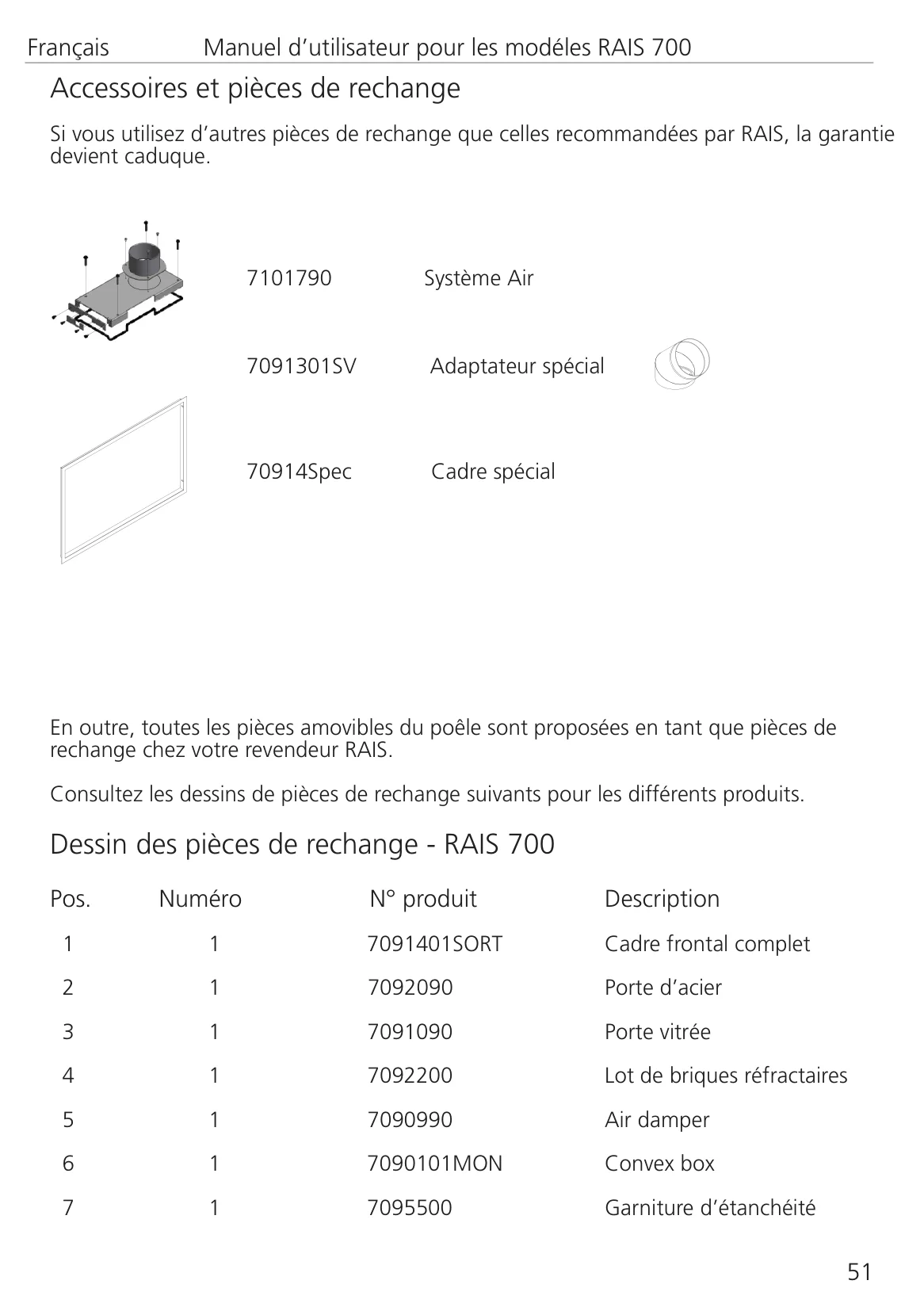
Accessoires et pièces de rechange
Si vous utilisez d’autres pièces de rechange que celles recommandées par RAIS, la garantie
devient caduque.
7101790 Système Air
70914Spec Cadre spécial
7091301SV Adaptateur spécial
En outre, toutes les pièces amovibles du poêle sont proposées en tant que pièces de
rechange chez votre revendeur RAIS.
Consultez les dessins de pièces de rechange suivants pour les différents produits.
Dessin des pièces de rechange - RAIS 700
Pos. Numéro N° produit
Description
1
1
7091401SORT
Cadre frontal complet
2
1 7092090
Porte d’acier
3
1
7091090
Porte vitrée
4
1
7092200
Lot de briques réfractaires
5
1
7090990
Air damper
6
1
7090101MON
Convex box
7
1
7095500
Garniture d’étanchéité
52
Flemish Gebruikershandleiding voor RAIS 700
STOOK MILIEUVRIENDELIJK!
5 milieuvriendelijke adviezen voor verstandig stoken
- gezond verstand, zowel voor het milieu als voor de portemonnee.
1. Efficiënt aanmaken. Gebruik droge twijgen, aanmaakhout en eventueel wat
krantenpapier. Open de luchttoevoer zodat er voldoende lucht kan binnen
stromen, zodat de gassen van het verwarmde hout snel opbranden.
2. Stook slechts met telkens een beetje brandstof, dat geeft de beste verbrand
ing. Vergeet niet veel lucht toe te voeren telkens wanneer u nieuw brand
hout in de kachel legt.
3. Als de vlammen minder hevig worden, moet de luchtklep aangepast wor
den, zodat de luchttoevoer verminderd wordt.
4. Als er alleen nog gloeiende houtskool over is, kunt u de luchttoevoer nog
lager zetten, zodat nog juist aan uw behoefte aan warmte wordt voldaan.
Met minder luchttoevoer brandt de houtskool langzamer en wordt het
warmteverlies via de schoorsteen gereduceerd.
5. Gebruik enkel droog hout, dat wil zeggen hout met een vochtigheidsgraad
tussen 15 en 22 procent.
De verpakking van het kachel kan worden gerecycleerd.
Ze moet worden uitgevoerd in overeenstemming met de plaat
selijke richtlijnen roind de afvoer van afval.
Het glas kan niet worden gerecycleerd.
Het glas moet worden afgevoerd samen met keramisch materi
aal en porcelein. Brandvast glas heeft een hogere smelttemper
atuur en kan dus niet worden gerecycleerd.
Zorg er voor dat geen brandvast glas is bij de ingeleverde pro
ducten . Dit is een belangrijke bijdrage aan het leefmilieu.
Onder voorbehoud van drukfouten
53
Flemish Gebruikershandleiding voor RAIS 700
Rais 700
Révision :
6
Date :
08-11-2021
INLEIDING....................................................................................................................................52
WAARBORG..................................................................................................................................52
SPECIFICATIES ..............................................................................................................................53
CONVECTIE .................................................................................................................................54
SCHOORSTEEN ............................................................................................................................54
VENTILATION.................................................................................................................................55
INSTALLATIE............................................................................................................................ 56-57
OPSTELAFSTANDEN................................................................................................................. 58-62
BRANDHOUT.................................................................................................................................63
DROGEN EN OPSLAAN..................................................................................................................63
DE VERBARNDINGSLUCHT AFSTELLEN ..........................................................................................64
GEBRUIK VAN DE KACHEL ...........................................................................................................64
INSTELLEN VAN DE KLEP................................................................................................................64
CONTROLE....................................................................................................................................64
EERSTE GEBRUIK .........................................................................................................................65
AANMAKEN EN BIJVULLEN ...........................................................................................................66
WAARSCHUWING.........................................................................................................................67
ONDERHOUD ..............................................................................................................................68
SCHOONMAAK VAN DE ROOKKANALEN .....................................................................................69
OPLOSSEN VAN PROBLEMEN.........................................................................................................70
ACCESSORIES EN RESERVEONDERDELEN / TEKENINGEN VAN RESERVEONDERDELEN....................71
54
Flemish Gebruikershandleiding voor RAIS 700
Inleiding
Gefeliciteerd met uw nieuwe RAIS houtkachel!
Een RAIS houtkachel is meer dan zomaar een warmtebron: ze toont aan dat u uw huis wil
inrichten met perfect ontworpen kwaliteitsproducten.
Om het maximum te halen uit uw nieuwe houtkachel, is het belangrijk dat u deze
handleiding grondig leest vóór u de kachel installeert en gebruikt.
In verband met de waarborg en latere referenties kunt u best het productienummer van
uw kachel noteren. We bevelen u aan het in het vakje te schrijven dat daarvoor links is
voorzien. De producte nummer is geplaatst op de bovenkant van de convectie boks.
Waarborg
Uw RAIS kachel krijgt vijf jaar waarborg mee. Deze waarborg geldt niet voor
isolatiemateriaal, glas en pakkingen. De waarborg vervalt indien aan de kachel gelijk welke
wijzigingen worden aangebracht.
Verkoper:
Datum :
55
Flemish Gebruikershandleiding voor RAIS 700
Specificaties
RAIS 700
Nominaal vermogen (kW):
5,2
Min./Max. vermogen(kW):
3-7
Verwarmde oppervlakte (m2):
ca. 60-105
Breedte/diepte/hoogte kachel (mm):
864-484-574
Breedte/diepte/hoogte stookplaats (mm):
562-289-300
Aanbevolen hoeveelheid hout (kg):
(2 tot 3 blokken van elk 25 cm lang)
1,8
Min. trek van de kachel (Pascal):
-12
Gewicht (kg):
125
Effectiviteit (%):
80
Deeltjes naar gelang NS3058/3059 (g/kg):
2,6
Stof afgemeten naar gelang Din+(mg/Nm³):
8
Rookgas massa strook (g/s):
5,1
Temperatuur rookgas (°C)
268
Bijvullen:
Vul de kachel elke drie uur bij
56
Flemish Gebruikershandleiding voor RAIS 700
Convectie
Alle RAIS kachels zijn convectiekachels, wat betekent dat de zijkanten nooit te heet
worden. Bij convectie wordt aan de onderzijde van de kachel koude lucht in het systeem
gezogen. Deze lucht gaat dan naar boven door de convectieleiding, die naast de ver
brandingskamer ligt. De opgewarmde lucht komt vrij aan de bovenzijde van de kachel,
zodat in de ruimte een snelle luchtcirculatie ontstaat.
RAIS kachels zijn uitgerust met luchtgekoelde handgrepen. Dankzij deze RAIS specialiteit
kunt u de handgreep van uw kachel aanraken zonder handschoen, hoe heet de kachel
ook is. Zorg er wel voor dat u zeer voorzichtig bent wanneer u onderdelen aanraakt ter
wijl de kachel nog heet is.
Schoorsteen
De schoorsteen is de motor van uw kachel. Zelfs de beste kachel zal niet goed werken
wanneer de correcte en noodzakelijke trek niet beschikbaar is en wanneer de schoorsteen
niet correct is geïnstalleerd.
De schoorsteen moet hoog genoeg zijn (minimum 3 meter) om de nodige trek van 14-18
Pascal mogelijk te maken. Als de aanbevolen trek niet wordt bereikt, kan er uit de kachel
rook in de kamer komen bij het bijvullen.
Schenk extra aandacht aan de trek als u een schoorsteen met twee rookkanalen gebruikt.
RAIS kachels zijn geschikt voor installatie met een rookverbindingsstuk, maar we raden aan
om tussenstukken te plaatsen met een onderlinge afstand van minimum 250 mm.
De aansluitkraag heeft een diameter van 150 mm.
Bij te hevige trek is de installatie van een demper op de schoorsteen of het rookkanaal aan
te bevelen. Als een demper wordt geïnstalleerd, moet hij een open ruimte van minstens 20
cm² in gesloten stand hebben. Dit zorgt ervoor dat de energie van het brandhout optimaal
wordt benut. Hebt u vragen over de toestand van uw schoorsteen, contacteer dan uw
schoorsteenveger of uw RAIS dealer.
Denk eraan dat u de toegang tot de reinigingsdeur vrij laat.
57
Flemish Gebruikershandleiding voor RAIS 700
Ventilatie - maak het beste mogelijk gebruik van de kachel.
De kachel is uitgerustet met vier convectie lucht uitlaate.
58
Flemish Gebruikershandleiding voor RAIS 700
Installatie
De onderstaande regels moeten worden gevolgd vóór en tijdens de installatie.
De installatie van de kachel moet beantwoorden aan alle nationale en lokale regels en
voorschriften. Bovendien raden we u aan om vóór de installatie de plaatselijke overheid en
een schoorsteenveger te contacteren.
Onbevoegden mogen geen wijzigingen aanbrengen aan de kachel.
OPMERKING: vóór de kachel wordt gebruikt, moet u de installatie melden aan uw
schoorsteenveger.
Om een efficiënte verbranding te garanderen, moet er voldoende verse luchttoevoer zijn
in de ruimte waar de kachel wordt geplaatst. Houd er rekening mee dat een mechanische
uitlaat, zoals een keukenventilator, de luchttoevoer kan beperken.
De oven is bovenaan voorzien van twee uitlaten, die moeten verbonden worden met de
juiste luchtkanalen i de kamers die men wenst te verwarmen.
De vloer moet voldoende stevig zijn om het gewicht van de kachel en eventueel de
schoorsteen te dragen.
Installeer uw RAIS kachel in een ruimte van waaruit u zoveel mogelijk warmte naar andere
kamers kunt leiden. Plaats uw kachel op een veilige afstand van brandbaar materiaal.
Verkleuring van verf kan voorkomen nabij de uitlaat van convectielucht en boven de
deksels van de ovens.
Zie de plaat van de fabrikant op de houtkachel.
3 opties
59
Flemish Gebruikershandleiding voor RAIS 700
Montagehandleiding
Inbouw van de oven:
OPMERKING:
U dient na te denken over de plaatsing van de toevoer- en afvoer-
openingen van het convectiesysteem. De eisen met betrekking tot
oppervlakte dienen te worden nageleefd.
Er kan verkleuring van de wand optreden boven de deksels van de oven en
de afvoeropeningen van het convectiesysteem. Dit komt door het opstijgen
van de warme lucht.
RAIS aanvaardt geen enkele aansprakelijkheid voor de inbouw of gevolgs
chade.
Gelieve de oven bij ontvangst na te kijken op defecten.
Neem de oven van het palet af en plaats de oven op de gewenste plek op een aangepa
ste onderlaag. De meegeleverde poten beantwoorden aan de minimale installatiehoogte.
Indien de oven hoger moet worden geplaatst, kunt u verstelbare poten gebruiken (acces
soires zijn te koop bij uw RAIS-verdeler).
Stel de oven bij met behulp van verstelschroeven, zodat de bovenzijde van het glazen dek
sel in de gesloten stand horizontaal is en het oppervlak van het glas in de gesloten stand
verticaal is.
Demonteer dekplaten en deuren van het inzetstuk. Draag zorg voor het glas van de
deuren, aangezien zij door stoten en kloppen gemakkelijk kunnen worden beschadigd.
Laat de beschermende tape op het roestvrije klephandvat zitten. Bescherm de geverfde
oppervlakken van de oven tegen cement- en verfdruppels.
Monteer het niet-geïsoleerde deel van de schoorsteen op de rookaansluiting in de conve
ctiekast. Het is belangrijk dat de verbinding tussen de rookbuis en de oven overal dicht zit.
Daarom bevelen wij aan deze met een pakking te dichten wanneer u ze met elkaar verbindt.
Monteer het geïsoleerde deel van de schoorsteen en verbind het eventueel met en bakste
nen schoorsteen.
Monteer indien nodig de verse-luchtaansluiting op het aansluitstuk terug de oven.
Indien u buizen op de uitlaataansluitingen van het convectiesysteem wenst te monteren,
kunt u dit het beste doen vóór u met de inbouw begint.
De oven is gereed om hetzij in een paneelwand, hetzij in een bakstenen muur te worden
ingebouwd.
Nadat de muur is afgewerkt en eventueel geverfd, worden de afdekplaten en de deuren
gemonteerd.
De afdekplaten zijn door de fabriek afgesteld op de maximale muurdikte. Draai de schro
even bovenaan en onderaan los. Duw de afdekplaten tegen de muur. Controleer of de
afdekplaten evenwijdig zijn met de muur en met het glas van de afdekplaat in gesloten
toestand; indien nodig wordt de afdekplaat bijgesteld.
Indien u dit wenst, kan er een afdekplaat met speciale afmetingen geleverd worden.
Neem contact op met uw RAIS-verdeler. U kunt deze plaat samen met de oven bestellen.
60
Flemish Gebruikershandleiding voor RAIS 700
Opstelafstanden van paneelwand – brandbare materialen (isolatievermogen
als Aqua-paneel (warmtegeleidingscijfer 0,36 W/mk) of beter).
A-A
AA
110
Min.
mm
850
min.
mm
Virje afstand
400
materialen min.
mm
Afstand tot brandbare
300
materialen min .
mm
Afstand tot brandbare
(bv. zijwand)
200
materialen min.
mm
Afstand tot brandbare
(bv. deurframe)
100
Min.
mm
100
Min.
mm
300
Min.
mm
Minimale convectieruimte 800 cm²
boven de oven (kan verdeeld worden)
Minimale convectieruimte 530 cm²
onder de oven (kan verdeeld werden)
300
materialen min.
mm.
Afstand tot brandbare
NB!!
Geïsoleerde schoorsteen omlaag
tot de rookverbinding
700
min.
mm
Afstand tot
meubelen
61
Flemish Gebruikershandleiding voor RAIS 700
Opstelafstanden van super isol.
A-A
AA
Minimale convectieruimte 800 cm²
boven de oven (kan verdeeld worden)
Minimale convectieruimte 530 cm²
onder de oven (kan verdeeld werden)
300
materialen min.
mm
Afstand tot brandbare
850
min.
mm
Virje afstand
400
materialen min.
mm
Afstand tot brandbare
110
Min.
mm
50
Min.
mm
50
Min.
mm
200
materialen min.
mm
Afstand tot brandbare
(bv. deurframe)
300
materialen min.
mm
Afstand tot brandbare
(bv. zijwand)
300
Min.
mm
700
min.
mm
Afstand tot
meubelen
NB!!
Geïsoleerde schoorsteen
omlaag tot de
rookverbindingInsulated
62
Flemish Gebruikershandleiding voor RAIS 700
Opstelafstanden van baksteenwand / brandmuur
Indien er niet voor voldoende convectie gezorgd wordt, kan dit leiden tot beschadiging
van bakstenen muren.
A-A
AA
110 mm
700
min.
mm
Afstand tot
meubelen
400
materialen min.
mm
Afstand tot brandbare
850
min.
mm
Virje afstand
300
materialen min.
mm
Afstand tot brandbare
0
brandnuur mm
Opstelafstanden van
(10 mm aanbevolen)
0
brandmuur mm
Opstelafstanden van
(10 mm aanbevolen)
300
Min.
mm
Minimale convectieruimte 800 cm²
boven de oven (kan verdeeld worden)
Minimale convectieruimte 400 cm²
onder de oven (kan verdeeld worden)
63
Flemish Gebruikershandleiding voor RAIS 700
Aqua panneau
Super isol
Murs de briques
Installatie - (hoogte x lengte) 545 x 840
Een inzetstuk voor een houtkachel moet nooit nauw aansluiten. Staal zet uit bij verhitting.
545
Min.
mm
850
Min.
mm
415
Min.
mm
5
Min. mm
1025
Min.
mm
590
Min.
mm
545
Min.
mm
5
Min. mm
581
Min.
mm
925
Min.
mm
545
Min.
mm
5
Min. mm
Attention!
Pour des raisons de possibilités de
réglage pour la vis de réglage doit
être le niveau de la fondation pour
min. 5 mm sous le bord horizontal
à l'avant
64
Flemish Gebruikershandleiding voor RAIS 700
AA
864
782
489
574
127 191,7
191,7
191,7 127
n150
n147
203
A-A
403
461
45°
541
548
65
Flemish Gebruikershandleiding voor RAIS 700
Brandhout
Uw RAIS kachel is ontworpen en EN-gecertificeerd voor het branden van gekliefd en
gedroogd brandhout Het brandhout mag slechts 15-22% water bevatten en een
maximale lengte hebben van ongeveer 28 cm, of de breedte van de stookplaats min 50-60
mm.
Nat hout verbranden is niet economisch voordelig en veroorzaakt roet en andere stoffen
die schadelijk zijn voor het milieu. Pas gekapt hout bevat 60-70% vocht en is daardoor
ongeschikt als brandstof. Gekliefd hout moet minstens twee jaar worden opgeslagen vóór
het als brandstof wordt gebruikt.
Brandhout met een diameter van meer dan 100 mm moet worden gekliefd. Ongeacht de
grootte van het hout moet het oppervlak vrij zijn van schors.
Gebruik geen behandeld of geverfd hout, gelamineerd hout, hout met kunststofbekleding,
triplex, kolen, papieren briketten of afval (plastic en andere soorten kunststoffen stoten
schadelijke gassen uit) als brandstof voor uw RAIS houtkachel. Gebruikt u dergelijke
materialen of meer brandhout dan aanbevolen, dan wordt uw kachel blootgesteld aan
een te grote hitte. Dat zal leiden tot hoge temperaturen in de schoorsteen en een lagere
efficiëntie. Bovendien kunnen uw kachel en schoorsteen worden beschadigd, en zal uw
waarborg vervallen.
Hoe goed hout brandt, hangt nauw samen met de hoeveelheid vocht die het bevat. Een
hoge vochtigheid leidt tot minder warmte: hoe meer water in het brandhout, hoe meer
energie verloren gaat om dat water te doen verdampen.
De verwarmingswaarde van verschillende soorten hout die twee jaar gedroogd zijn en een
vochtgehalte hebben van 15-20% leest u af uit de onderstaande tabel.
Houtsoort
Droog hout kg/m3 In Vergelijking met beuk/eik
Haagbeuk
640
110 %
Beuk en eik
580
100 %
Es
570
98 %
Esdoorn
540
93 %
Berk
510
88 %
Bergden 480
83 %
Spar
390
67 %
Populier
380 65 %
Alle houtsoorten geven dezelfde warmte af per kg, maar de densiteit is niet dezelfde. Een
voorbeeld: 1 kg beuk neemt minder plaats in dan 1 kg spar.
Drogen en opslaan
Hout heeft tijd nodig om te drogen. Hout dat als brandstof wordt gebruikt, moet minstens
twee jaar drogen voor een optimale verbranding. Klief het hout vóór u het opslaat en
stapel het op een luchtige, droge en zonnige plaats, beschermd tegen de regen. De
zuidkant van het huis is gewoonlijk geschikt voor het opslaan. Laat voor een goede
verluchting voldoende ruimte tussen de op elkaar gestapelde rijen. Dek de houtstapels niet
af met plastic, want dat belet het hout om goed te drogen. Het is nuttig de blokken twee
of drie dagen vóór gebruik binnen in huis te leggen.
66
Flemish Gebruikershandleiding voor RAIS 700
De verbrandingslucht afstellen
Alle RAIS kachels zijn uitgerust met een makkelijk te bedienen hendel voor het afstellen van
de luchttoevoer. De illustraties tonen u de verschillende standen.
Primaire lucht is de lucht die wordt toegevoerd naar de primaire verbrandingsruimte of de
aslaag. Deze (koude) lucht wordt enkel gebruikt bij het opstarten.
Secundaire lucht zorgt voor het verbranden van de gassen bij hoge temperaturen
(voorverwarmde lucht die wordt gebruikt voor luchtspoeling en verbranding). Deze lucht
komt in de kachel onder de stookplaats. Ze wordt opgewarmd in de zijkanalen en dan
naar het glas gestuurd. De hete lucht stroomt langs de ruit en houdt ze roetvrij. Aan de
achterzijde van de stookplaats bevindt zich bovenaan een tertiair kanaal. De tertiaire lucht
helpt de overblijvende gassen verbranden.
Als u de luchttoevoer tussen stand 1 en 2 plaatst, komt er voldoende zuurstof voor de
verbranding in de kachel en wordt de brandstof optimaal benut. De luchttoevoer is correct
afgesteld wanneer de vlammen helder en geel zijn. De juiste stand vinden vergt wat
zoekwerk, maar gaat erg
makkelijk.
Het wordt aanbevolen om de luchttoevoer nooit volledig te sluiten wanneer u de kachel
gebruikt. Een typische fout is dat men de toevoer te snel sluit, omdat de hitte te intens
wordt. Dat veroorzaakt een donkere rookwolk uit de schoorsteen, wat betekent dat de
energiewaarde van het hout niet correct wordt gebruikt.
Gebruik van de kachel
Instellen van de klep. De klep heeft drie mogelijke instellingen.
Stand 1
De luchtklep is bijna gesloten, zodat de luchttoevoer minimaal is.
Stand 2
Trek het handvat tot de eerste klik. In deze stand is er volledige toevoer van secundaire
lucht. Bij gewone verbranding plaatst u het handvat tussen 1 en 2.
Wanneer de vlammen helder geel zijn, is de klep correct ingesteld, d.w.z. dat de verbrand
ing langzaam/optimaal verloopt.
Stand 3
Trek het handvat to de volgende klik. Nu staat de luchtklep volledig open en hebt u volle
dige toevoer van primaire en secundaire lucht. Deze stand wordt tijdens de aanmaakfase
gebruikt, niet tijdens de normale werking.
Controle
Wanneer de as wit is en de wanden van de verbrandingskamer vrij zijn van roet nadat
de kachel gebruikt is, betekent dit dat de luchttoevoer correct was en dat het brandhout
voldoende droog was.
67
Flemish Gebruikershandleiding voor RAIS 700
Eerste gebruik
Behandel uw kachel met zachtheid en u zult er later de vruchten van plukken. Begin met
een klein vuur, zodat uw kachel kan wennen aan hoge temperaturen. Dit is de beste
manier om te starten en het voorkomt mogelijke schade.
De eerste paar keren kunt u een vreemde geur waarnemen, die afkomstig is van
de werking van de hitte op de verf en de materialen. Dat is normaal en het zal snel
verdwijnen. Zorg er gewoon voor dat er veel frisse lucht in de kamer is wanneer u het vuur
aansteekt.
Let erop dat u tijdens het aansteken de geverfde oppervlakken niet aanraakt. Open en sluit
de deur regelmatig om te voorkomen dat de fittingen zouden kleven.
Tijdens het eerste opwarmen en afkoelen kan het metaal wat klikgeluiden maken, omdat
het wordt blootgesteld aan grote temperatuurschommelingen. Ook die geluiden zijn
normaal en zullen verdwijnen.
Gebruik nooit vloeibare brandstof om het vuur aan te steken of aan de gang te houden,
want dit veroorzaakt ontploffingsgevaar.
Als u de kachel een tijd niet hebt gebruikt, ga dan op dezelfde manier te werk als de eerste
maal.
68
Flemish Gebruikershandleiding voor RAIS 700
Aanmaken en bijvullen
Voor het aanmaken gebruikt u aanmaakblokjes of iets dergelijks, alsmede ongeveer 2 kilo
gram kachelhoutjes. De luchtklep moet helemaal open worden gezet.
TIP vóór u de kachel aanmaakt:
Open een deur of venster in de buurt van de houtkachel.
Om te controleren of de schoorsteen ”trekt”, kunt u wat ineengenfrommeld krantenpaier
tussen de bovenste rookplaat en de schoorsteen steken(1), waarna u het krantenpapier
aansteekt(2) en wacht tot u ”gebulder” hoort in de schoorsteen(3). Dan bent u er zeker
van dat de schoorsteen trekt en voorkomt u dat er rook in de kamer ontstaat.
Steek het vuur aan en zet het kacheldeurtje op een kier van ongeveer 10 à 15 mm.(4-5)
Wanneer de vlammen helder zijn - na 5 à 10 minuten - sluit u het kacheldeurtje.(6)
Luchtklep: zie de instelling van de luchtklep.
Wanneer er zich na 10 à 20 minuten een goede gloeilaag heeft gevormd(7), legt u er 2 à
3 houtblokken op.
Zet het kacheldeurtje op een kier tot het hout goed brandt. Doe het deurtje daarna
dicht(8-9).
Luchtklep: zie de instelling van de luchtklep.
Na ongeveer 5 minuten, of wanneer de vlammen helder geel zijn, sluit u de luchtklep
geleidelijk(10).
Een aslaag van ongeveer 20 mm is gunstig, aangezien die een isolerend effect heeft.
OPMERKING:
Wanneer de kachel eenmaal brandt, moet het deurtje altijd gesloten blijven.
69
Flemish Gebruikershandleiding voor RAIS 700
Als er slechts een paar gloeiende
kolen overblijven moet u het vuur
weer aansteken.
Als je gewoon nieuwe kolen toevoegd en
het vuur niet opnieuw aansteekt zullen
de kolen niet oplichten, maar worden er
onverbrande uitlaatgassen ontwikkeld.
Hier is brandhout toegevoegd aan een
gloeiend laag kolen die te klein is, en de
luchtstroom is te klein - rook is ontwik
keld.
Vermijd zware rook - gevaar van een
uitlaatgassen explosie.
In het geval van zeer zware rook, open
de deur en maak het vuur opnieuw
aan.
WAARSCHUWING!!
Als het brandhout heel zachtjes brandt zonder vlammen of rook, en er te weinig lucht
wordt toegevoegd, zullen onverbrande uitlaatgassen worden ontwikkeld.
Uitlaatgassen kunnen worden ontstoken en ontploft, wat leidt tot schade aan het ma
teriaal en kan eventueel ook een persoonlijk letsel teweegbrengen.
Sluit nooit de volledige luchttoevoer af bij het aansteken van
het vuur in de kachel.
Voorbeelden van foto’s
70
Flemish Gebruikershandleiding voor RAIS 700
Onderhoud
Laat uw schoorsteen en kachel eenmaal per jaar nakijken door een professionele
schoorsteenveger. Tijdens het schoonmaken, nakijken of herstellen moet de kachel koud
zijn.
Als er zich roet bevindt op het glas van de deur, bevochtig dan een stuk papier of
krantenpapier, duw het even in de koude as en wrijf ermee over het glas. Gebruik een
ander stuk papier om op te poetsen en het glas zal opnieuw schoon zijn. U kunt ook de
glasreiniger gebruiken die te koop is bij uw RAIS dealer.
De andere delen kunt u schoonwrijven met een droge spons.
De stookplaats schoonmaken:
Verwijder de as en bewaar hem in een niet-brandbare houder tot hij is afgekoeld. Nadien
kunt u de as in de vuilnisbak gooien.
Denk eraan dat u NOOIT alle as uit de verbrandingskamer mag verwijderen. Laat een laag
van ongeveer 20 mm liggen voor een betere verbranding.
Bij de start van een nieuw kachelseizoen moet u de schoorsteen en de rookkanalen
nakijken op eventuele verstoppingen.
71
Flemish Gebruikershandleiding voor RAIS 700
Schookmaak van de rookkanalen
Het rookkanaak bestaat uit een vuurplaat en
een rookgeleider bovenaan. Deze onderdelen
worden aan elkaar geschroefd. Beide onderdelen
zijn uit vermaculiet vervaardigd. Behandel deze
onderdelen voorzichtig.
Verwijde de vuurplaat door ze aan één kant op
te tillen en naar u toe te trekken.
Neem de vuurplaat er voorzichtig uit.
Nu hebt u een duidelijk zicht op de rookuitgang.
Verwijder stof en vuil en plaats de onderdelen
terug in omgekeerde volgorde.
NB!!
Zorg ervoor dat de vuurplaat overeenkomt met
de opening aan de achterkant van de kachel.
72
Flemish Gebruikershandleiding voor RAIS 700
Oplossen van problemen
Er ontsnapt rook uit de deur:
• Er is onvoldoende trek in de schouw (<12 Pa)
• Kijk na of de schoorsteen of het rookkanaal verstopt is
• Kijk na of de keukenventilator in gebruik is; is dat het geval, zet hem dan uit en
open even het raam
Roet op het glas:
• Het hout is te vochtig
• Zorg ervoor dat de kachel voldoende is opgewarmd vóór u de deur sluit
• De luchttoevoer staat onvoldoende open
De kachel brandt te snel:
• De fitting zit misschien te los
• De trek in de schoorsteen kan te hoog zijn (>22 Pa); is dat het geval, installeer
dan een demper
De kachel brandt te langzaam:
• Te weinig brandhout
• Er komt onvoldoende lucht in de kachel
• Het rookkamersysteem is niet schoongemaakt
• De schoorsteen lekt
• Een lek tussen schoorsteen en rookkanaal
Als de problemen blijven aanhouden, raden we u aan uw schoorsteenveger of uw RAIS
dealer te contacteren.
73
Flemish Gebruikershandleiding voor RAIS 700
Accessoires en reserveonderdelen
Indien u gebruik maakt van andere reserveonderdelen dan degene die RAIS aanbeveelt,
vervalt de waarborg.
7101790 Air-systeem
70914Spec Special voorkader
7091301SV Special adapter
Verder kunnen alle vervangbare onderdelen als reserveonderdelen bij uw RAIS-verkoper
worden aangekocht.
Zie de hierna volgende tekeningen van reserveonderdelen voor de afzonderlijke produc
ten.
Tekening van reserveonderdelen RAIS 700
Ref. Aantal Productnummer
Beschrijving
1
1
7091401SORT
Compleet voorkader
2
1 7092090
Stalen deur
3
1
7091090
Glazen deur
4
1
7092200
Skamol-set
5
1
7090990
Luchtsysteem
6
1
7090101MON
Convectie box
7
1
7095500
Set pakkingen
RAIS A/S
Industrivej 20
DK-9900 Frederikshavn
www.rais.dk